June 26, 2026

Key takeaways
- Volatility returned, but market fundamentals have not broken. Markets are reassessing AI leadership and inflation risk, while earnings remain supportive.
- AI pulled back because expectations are high. The long-term thesis remains intact, but crowded positioning and rising capital spending are increasing investor sensitivity to whether AI investment can ultimately generate attractive returns.
- Inflation concerns matter because rates are the pressure point. Inflation fears eased as energy prices retreated, but stronger inflation and labour market data reduced confidence that central banks will provide near-term support.
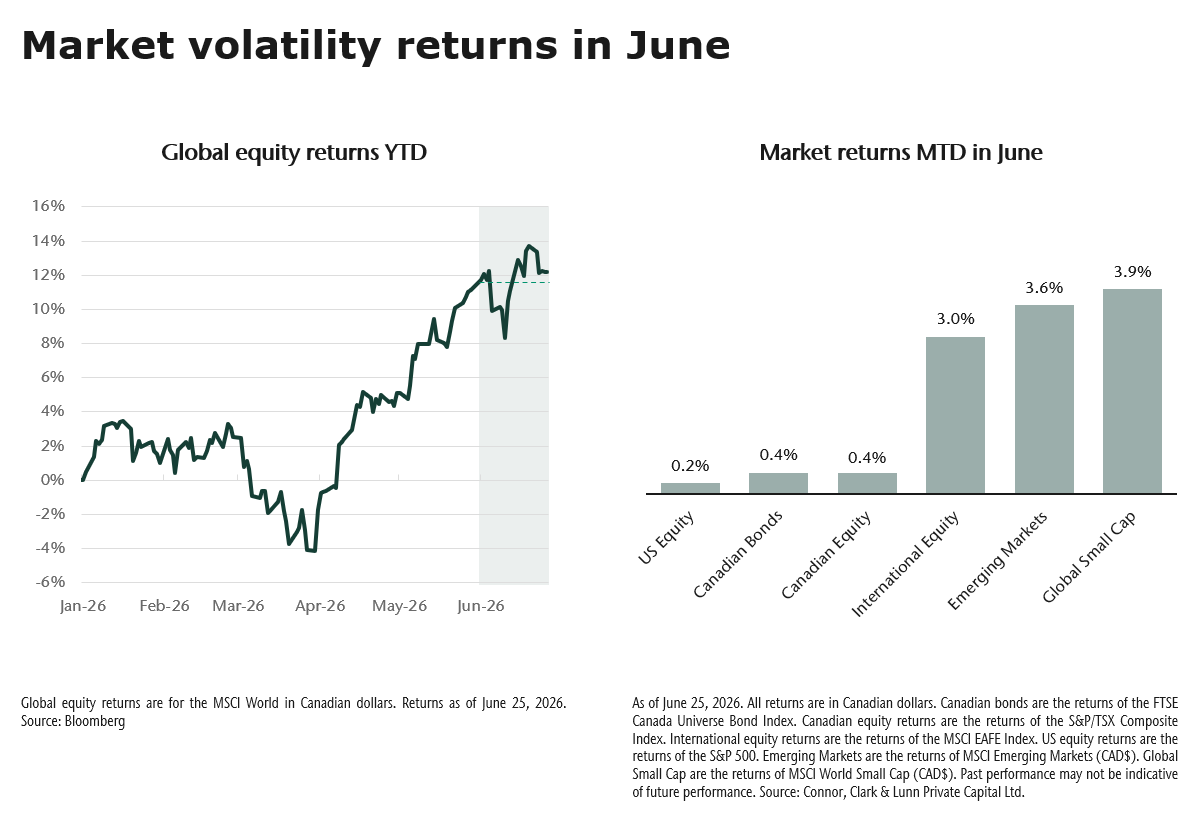
April and May were strong months for equity markets, but June was more uneven. Volatility returned, but so far it looks more like a market digesting strong gains than signaling a broader loss of confidence in equities. Investors reassessed both major market narratives: artificial intelligence (AI) leadership and inflation risk. AI-related stocks sold off as positioning had become crowded and expectations were high, while inflation fears rose earlier in the month before easing more recently as energy prices retreated.
Earnings remained supportive, investor demand for equities stayed resilient, and corporate buybacks continued to provide a source of market support. The result was a less one-directional market: weakness in AI-related areas was partly offset by strength in more defensive sectors such as health care and utilities, as well as financials, which can benefit from higher interest rates. Diversification helped as AI declined, with emerging markets and developed international equities outperforming the United States (US) equity market.
AI remains the dominant theme, but the bar is higher
AI remains the most important equity market theme, but June showed that leadership can become volatile when expectations are this high. After a strong run, investors are increasingly focused on whether future revenue from AI can justify the scale of spending now underway. Capital spending expectations continue to rise, with spending as a share of sales now at an all-time high and expected to increase in the coming years. This makes investors more sensitive to whether future revenue growth can keep pace with the investment being made.
Part of the pullback also reflects positioning. Semiconductors, AI infrastructure and related technology stocks have been among the strongest areas of the market, leaving expectations high and the trade increasingly crowded. In this environment, even modest disappointments can create sharp corrections. Broadcom’s lower-than-expected guidance earlier in the month was a reminder that, after a period of strong returns, small changes in expectations can lead to a larger pullback.
The portfolio implication is not to abandon AI. The long-term thesis remains intact, and demand across semiconductors, memory, power and AI infrastructure remains strong. But the market is drawing a sharper distinction between companies benefiting today from the infrastructure buildout and companies where future AI benefits are still uncertain.
We continue to favour companies with tangible revenue tied to AI investment, while looking for longer-term beneficiaries that can use AI to improve productivity, strengthen competitive advantages, and generate durable returns. Canadian banks are one example. They are not direct AI infrastructure companies, but AI could improve efficiency in areas such as risk management, compliance, underwriting and fraud detection.
Inflation concerns resurfaced, but the real issue is central bank policy
Inflation concerns rose in June. Higher-than-expected US inflation data and a stronger labour market have challenged the view that inflation will steadily return to target. Oil prices have retreated from recent highs, helping ease near-term inflation concerns, but fiscal spending, resilient demand, tight labour markets, and the AI investment cycle continue to complicate the inflation outlook.
The important shift is in interest rate expectations. Investors are no longer debating when central banks will cut rates; instead, they are considering whether inflation could force central banks to raise rates. The market can live with some inflation when growth and earnings are strong but it struggles when inflation is strong enough to push central banks toward tighter policy. That matters because rates are the pressure point for portfolios. Higher rates create a tougher backdrop for bonds, equity valuations, housing, and other interest-rate-sensitive parts of the economy.
Bottom line: portfolio construction matters when leadership is volatile
June was a reminder that market volatility will resurface, even when the underlying themes remain intact. AI continues to support earnings growth and capital spending, but the market is becoming more demanding about valuations and future profitability. Inflation concerns have eased somewhat, but the risk of stickier inflation and tighter central bank policy remains elevated.
This is why portfolios should not rely on one theme, one region, or one interest-rate outcome. We remain positioned to participate if growth continues, while balancing that exposure with areas that can behave differently, including Canadian equities, developed international and emerging market equities, credit, and alternatives. Diversification helped in June as AI leadership weakened, and it remains central to building portfolios that can endure when market leadership changes.