July 17, 2026
Key takeaways
- The Bank of Canada is comfortable holding rates steady for now. Inflation remains elevated mainly because of energy-related costs, while underlying inflation is close to target and economic growth is still recovering.
- Canadian businesses and the broader economy are adapting. Exports, consumer spending, housing and investment are contributing to a wider rebound, while companies are finding ways to operate through ongoing trade uncertainty.
- The improving backdrop creates selective opportunities in Canada. Attractive valuations and exposure to key sectors positioned to benefit from the AI investment cycle — including power, critical materials, and infrastructure — create a compelling environment for disciplined security selection.
Canada’s economic backdrop is becoming more encouraging. Growth is recovering, inflation pressures remain largely contained outside energy, and businesses are adjusting to an uncertain trade environment.
A steady hand from the Bank of Canada
The Bank of Canada (BoC) left its policy rate unchanged at 2.25% for a sixth consecutive meeting. The decision reflected a balance between two concerns: inflation remains somewhat elevated, but growth is still fragile enough that higher borrowing costs could slow the recovery.
Headline inflation rose because of higher gasoline prices and wider refining margins. However, the inflation measure excluding gasoline (the BoC’s preferred underlying measure) remains close to 2%. The central bank expects inflation to ease as energy prices normalize, but it is retaining flexibility if higher costs spread more broadly or growth weakens. It appears increasingly comfortable leaving rates where they are while waiting for clearer evidence on the economy.
Businesses are moving from uncertainty to action
Canadian companies are no longer simply waiting for greater clarity on trade policy, they are finding ways to adapt. Aluminum producers are reaching new buyers outside the US, while other firms are finding ways to navigate the changing trade environment. The BoC’s Business Outlook Survey for the second quarter of 2026 showed that exports to the US have strengthened, led by energy products, and that businesses have reported a better outlook for future export sales.
Several forces are supporting this activity. The US economy remains resilient, aiding demand for Canadian goods, while a weaker Canadian dollar makes those goods more competitive. At the same time, rising US investment in artificial intelligence (AI) is expected to increase demand for Canadian raw materials, metal products and electrical equipment. The trade risks have not disappeared, but companies are increasingly finding ways to navigate them.
The rebound is broader than the headline
The BoC estimates that Canadian GDP likely grew at a 2.5% annualized pace in the second quarter after stalling in the first. Exports are expected to be the largest contributor, but the increase is not limited to trade. Consumer spending, housing, government activity and business investment are also adding to growth. Imports and inventories offset part of the advance, but the overall picture is one of improvement across several parts of the economy rather than a single-sector bounce.
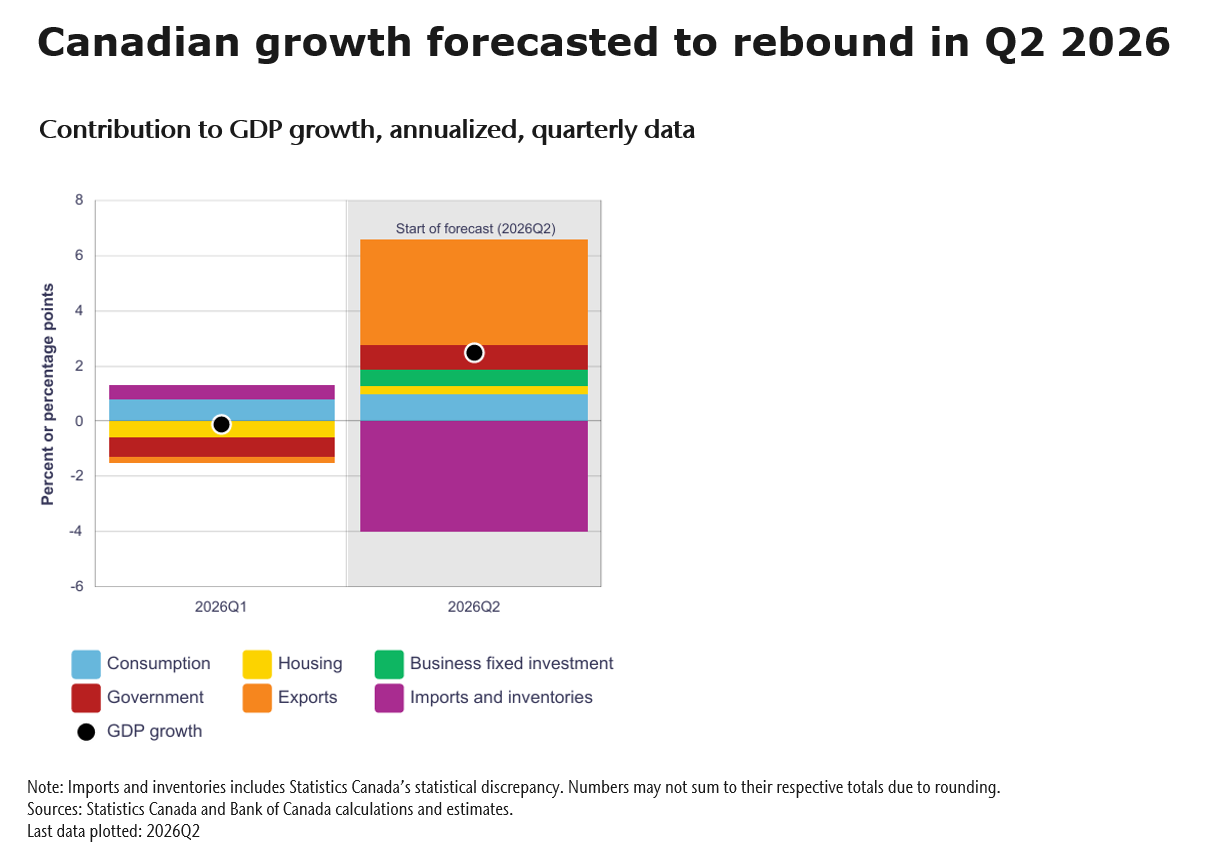
A recovery supported by several parts of the economy is more durable than one driven by a temporary surge in one area. It also suggests that the most difficult period may be behind us, even if growth remains uneven.
Resilience is creating a broader opportunity
The first half of 2026 tested Canada with an energy shock, persistent inflation concerns, and continued trade uncertainty. Yet the economy has not cracked. Businesses are adapting, exports are recovering, and growth appears to be broadening.
Canada is also well-positioned for several long-term investment themes. Rising global spending on AI, electrification, and power infrastructure are increasing demand for energy, copper, uranium and other materials in which Canadian companies have meaningful exposure. At the same time, Canadian equities are generally cheaper than comparable US equities. That could give them more room to rise if profits improve, while offering some cushion if economic growth is weaker than expected.
Risks remain. Households are still sensitive to borrowing costs, the labour market remains soft despite signs of stability, and trade negotiations could trigger renewed volatility.
For investors, the implication is not simply to own more of everything Canadian. It is to be selective — focusing on businesses with durable cash flows, attractive valuations, and exposure to areas where global demand is growing. Canada’s differentiated mix of financials, commodities, infrastructure and industrial businesses may offer attractive return potential while reducing reliance on a single area of the market. Discipline, diversification and thoughtful security selection remain the best ways to capture that opportunity.