June 05, 2026

Key takeaways
- Markets keep climbing despite rising risks because fundamentals remain strong.
- AI remains the dominant theme and investment leadership is broadening toward a wider group of companies.
- Conflict in the Middle East and oil prices remain the key macro risks to watch.
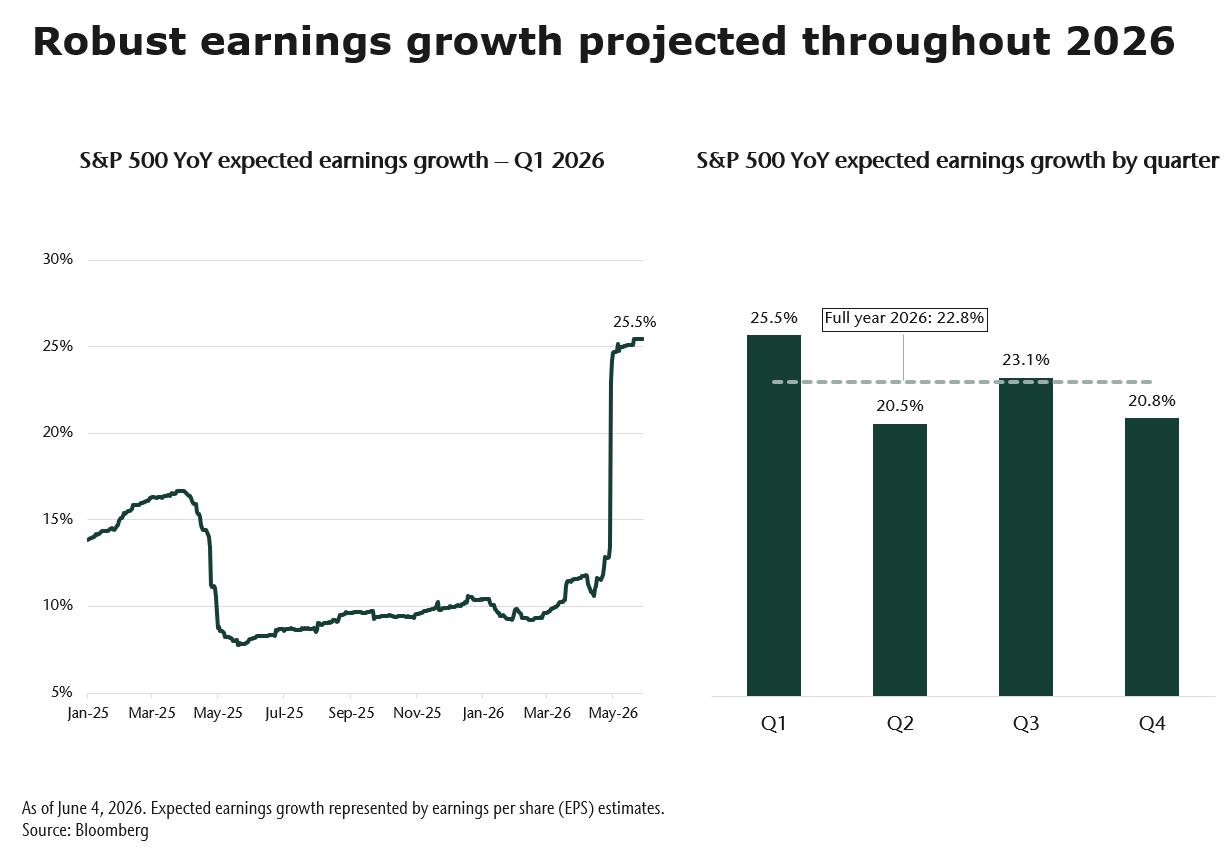
Equity markets have continued to move higher despite a more uncertain backdrop. Investors are weighing risks—including Middle East tensions, higher oil prices, firmer bond yields and policy uncertainty—but these are yet to derail the fundamentals that matter most: corporate earnings remain strong, spending by companies and consumers continues, and credit conditions remain supportive. In short, markets are not ignoring the risks, but they have not yet seen enough evidence that these are damaging the earnings outlook.
AI remains the dominant theme
The dominant market theme remains artificial intelligence (AI), but leadership within the theme is changing. In prior years, returns were heavily concentrated in Nvidia and large hyperscalers. Today, the AI ecosystem is becoming broader and more complex, creating new winners and losers across the value chain.
Investors are increasingly focused on where bottlenecks may emerge. Demand for memory, networking equipment, power generation, and semiconductor manufacturing equipment continues to accelerate. As a result, leadership has broadened beyond Nvidia and the hyperscalers toward companies such as AMD, Broadcom, Intel, and a range of infrastructure providers supporting the AI buildout. The market is becoming more selective, rewarding companies with visible demand, pricing power, and capacity constraints.
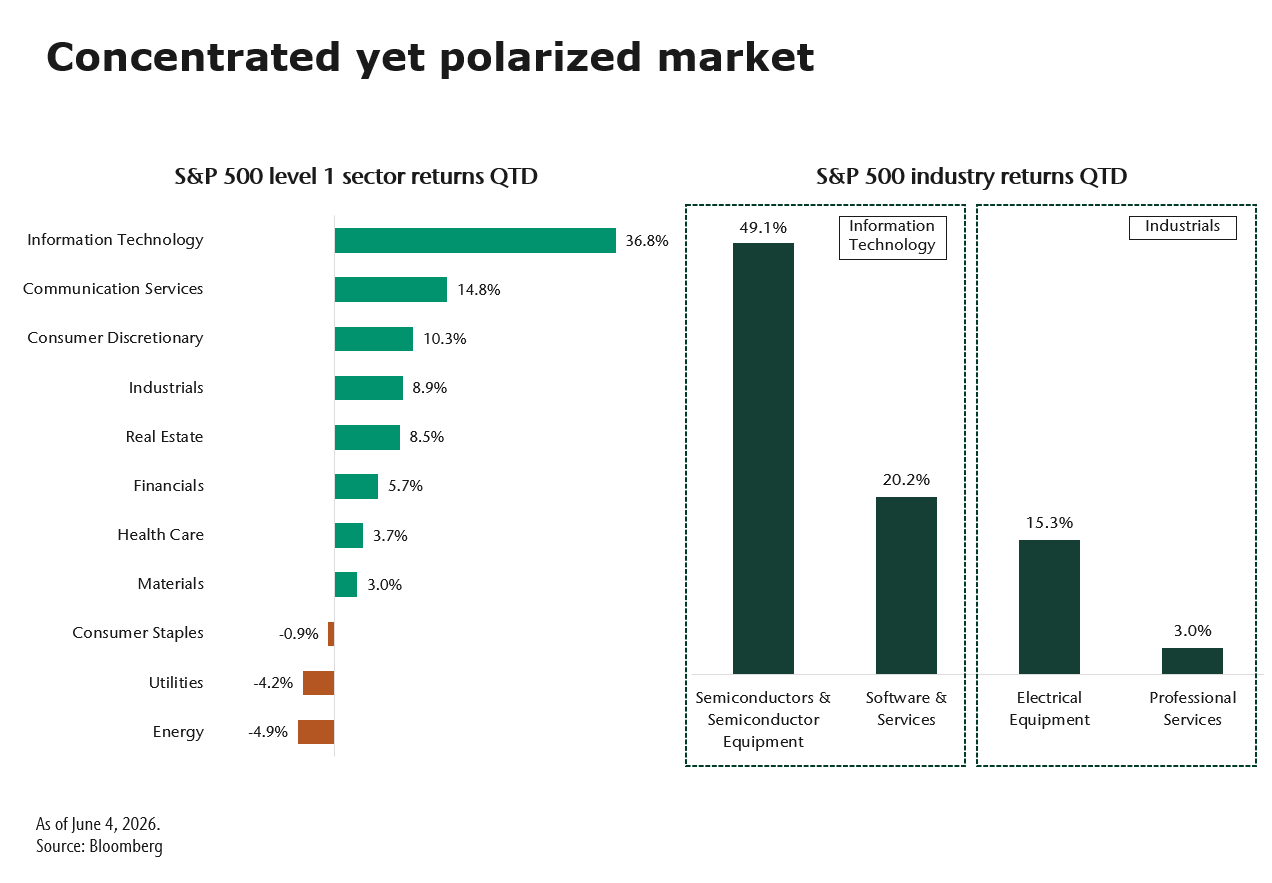
The chart below highlights the challenge of today’s market. Leadership remains highly concentrated in areas tied to AI, with Information Technology and Communication Services driving much of the return. But beneath the surface, performance is increasingly polarized. Semiconductors and semiconductor equipment have surged, while software and services have lagged. In Industrials, electrical equipment has benefited from AI-related power demand, while professional services have been weighed down by disruption concerns. The takeaway is that AI exposure alone is not enough. The market is rewarding companies tied to visible spending, capacity constraints and pricing power, while penalizing businesses where AI may threaten future growth.
Middle East conflict is the dominant risk
The most important macro risk remains the conflict in the Middle East and its impact on global oil supply. While oil prices have risen, they have not yet fully reflected what has become one of the largest supply disruptions in history. We are now roughly three months into the disruption—an important threshold, because temporary shocks can begin to have more lasting economic consequences if they persist.
The longer supply remains constrained, the greater the risk that higher energy costs feed through to inflation and ultimately slow economic growth. To date, markets have largely looked through these risks because the effects have not yet been material. However, with no clear end in sight, the likelihood is rising that higher oil prices will begin to weigh on both consumers and businesses.
Navigating this market
We continue to view AI as the dominant investment theme, but our implementation has evolved in our global fundamental equity portfolio. In prior years, portfolio positioning was concentrated around a small group of perceived winners. As leadership broadens, we are taking a more balanced approach.
We have reduced overweight positions in hyperscalers and expanded exposure across the broader AI infrastructure ecosystem, including semiconductors, memory, networking, power generation, and other beneficiaries of data centre investment. The objective is to participate in the continued growth of AI while reducing reliance on a narrow group of companies.
We remain underweight software and professional services. The market continues to price significant disruption risk into these sectors as AI capabilities improve. However, we do not view this as a permanent avoidance. Many software businesses possess valuable proprietary data, strong customer relationships, and attractive economics. If valuations continue to adjust, we see the potential for compelling long-term opportunities.
Bottom line
Markets continue to move higher because earnings remain stronger than the risks facing investors. The key debate is where the next phase of AI value creation will emerge.
We believe the opportunity set is becoming broader, extending beyond the Magnificent 7 into the infrastructure required to support AI adoption. At the same time, we remain mindful of growing macro risks, particularly around oil prices and economic growth. For investors, maintaining exposure to the AI opportunity while remaining diversified across the broader ecosystem is becoming increasingly important.