May 22, 2026
Key takeaways
- Markets are increasingly focused on inflation uncertainty and whether higher prices and interest rates could eventually begin to slow economic growth.
- Higher bond yields are creating a more challenging backdrop for markets, with fewer stocks driving overall returns and market leadership narrowing again.
- Despite rising uncertainty, equity markets have continued to reach new highs as the economy and corporate earnings have held up better than expected.
Markets have become increasingly focused on inflation and interest rates once more. Recent inflation data in the United States (US) and Canada came in higher than expected, driven largely by rising energy prices following renewed geopolitical tensions in the Middle East. However, market concerns extend beyond the near-term effects of the conflict. Investors are increasingly debating whether inflation pressures could prove more persistent — particularly as government spending remains high, business investment stays strong, and economic growth remains solid.
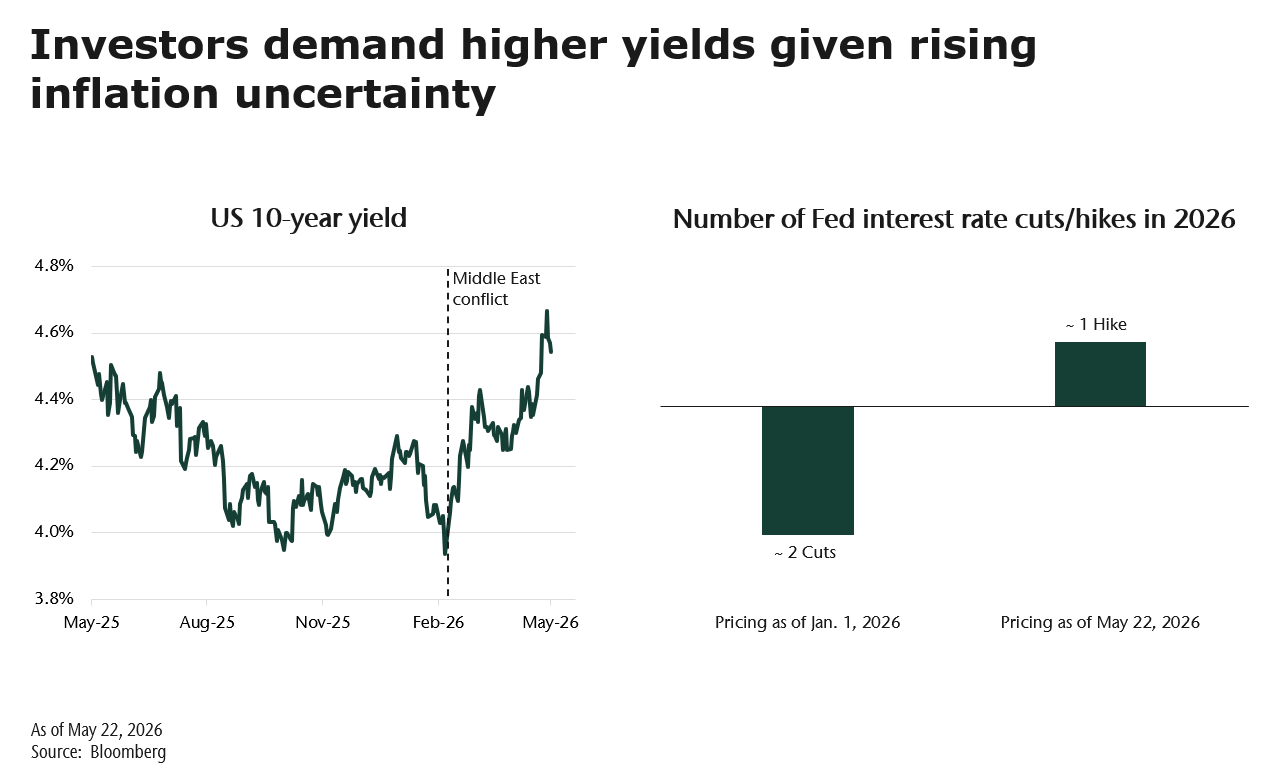
The greater concern is not simply that inflation remains somewhat elevated in the near term, but that a longer period of higher inflation and interest rates could eventually begin to slow growth. Higher energy prices act like a tax on consumers and businesses by increasing transportation, production and borrowing costs, leaving less money available for other spending across the economy. Earlier this year, markets expected approximately two interest rate cuts from the US Federal Reserve (Fed) in 2026. More recently, expectations have shifted toward roughly one interest rate hike, as inflation has proven more persistent than expected. While markets are not pricing in a return to the extreme inflation environment of past decades, they are adjusting to the possibility that interest rates may remain higher for longer than previously expected.
The market rally is narrowing again
Uncertainty around inflation and interest rates has pushed bond yields higher in recent weeks. While broader equity markets continue to hit record highs, leadership within the market has become increasingly narrow once more.
A small group of Artificial Intelligence (AI) and energy-related companies are driving a growing share of market returns, while many other areas of the market have generated more modest gains. This is a notable shift from earlier in the year, when inflation appeared more contained, bond yields were lower, and market gains were broader across sectors and regions.
Higher interest rates are making markets more selective. AI companies and businesses with strong earnings growth and pricing power continue to perform well, while more interest-rate-sensitive sectors are facing greater pressure. Utilities have weakened as rising bond yields make their dividend income less attractive relative to bonds, while construction and housing-related areas are being pressured by higher financing costs.
Higher interest rates are also making investors more selective about valuations. This is rewarding companies with strong earnings delivery while pressuring areas of the market where expectations had become more optimistic.
Bottom line
Markets are adjusting to a world where inflation may take longer to fully normalize and interest rates are likely to remain higher than many expected at the start of the year. Equity markets can continue moving higher in this environment, but returns are becoming less broad-based and increasingly concentrated among a smaller number of companies and themes driving strong earnings growth. We are watching closely to determine whether recent inflation and higher bond yields prove temporary or signal a more persistent shift in the market environment.