April 24, 2026
 Key takeaways
- Markets are being driven by fundamentals, with a stable economic backdrop allowing equities to look through geopolitical uncertainty.
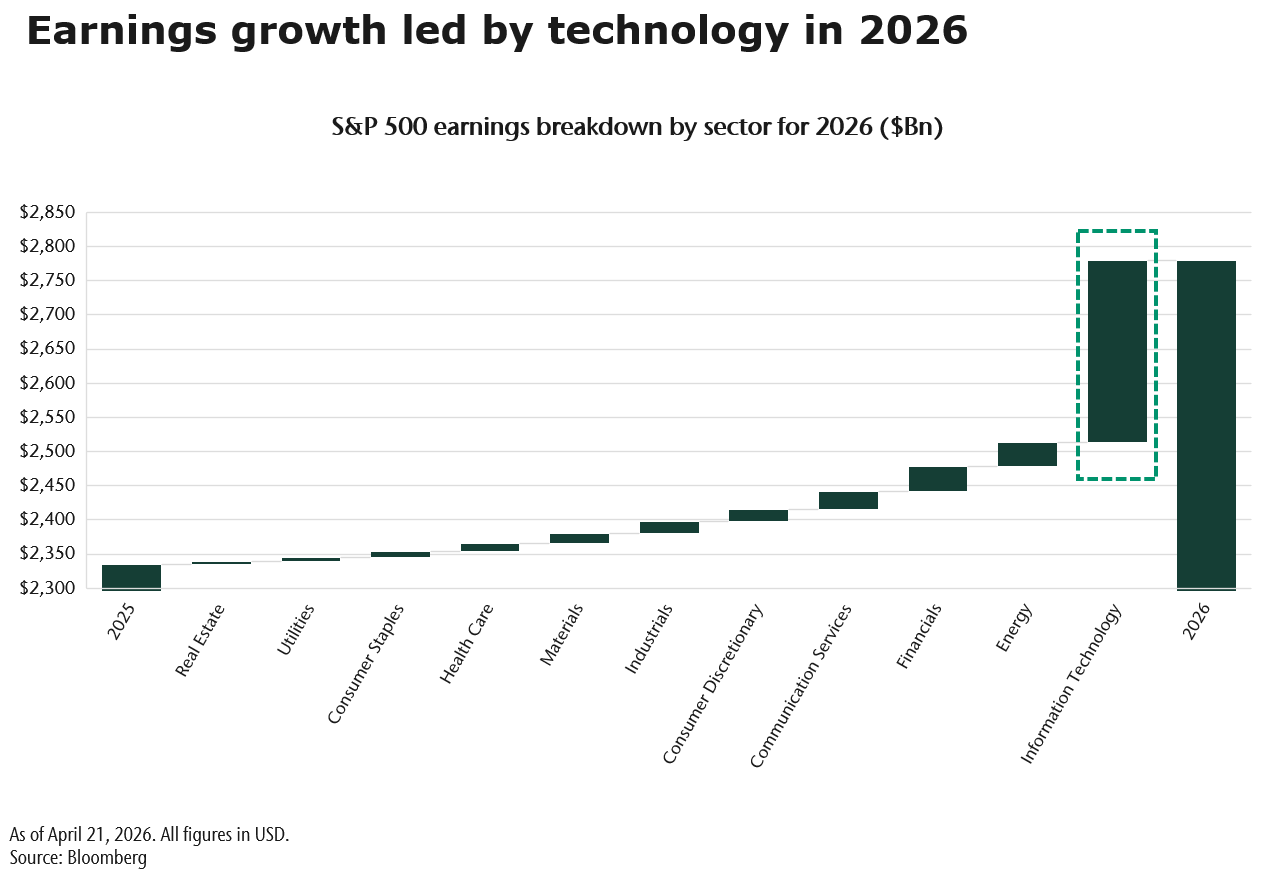
- Earnings growth remains the primary support, and technology is accounting for most of that expansion.
- AI leadership has re-emerged, with large-cap technology and semiconductor stocks leading markets higher as confidence in long-term growth returns.
Markets have continued to advance, reaching fresh record highs following the extension of the United States (US)-Iran ceasefire. While uncertainty remains — particularly with ongoing tensions in the Strait of Hormuz and oil prices back above $100 per barrel — equity markets have largely looked through these risks.
The key shift is that markets are moving away from reacting to geopolitical events. Investor focus has returned to what ultimately drives markets: earnings, economic growth, and long-term structural themes.
Earnings strength remains the anchor
Earnings continue to underpin markets, and the outlook is improving. Full-year S&P 500 earnings growth for 2026 is expected to be approximately 18%, with expectations trending higher. This is notable given the conflict in the Middle East and related supply chain disruptions have had less impact on overall earnings than initially feared.
One reason for this is that companies are better equipped to manage shocks. After multiple supply disruptions in recent years, many businesses have diversified sourcing and improved operational flexibility. While higher energy prices are affecting certain industries — particularly those with direct exposure, such as airlines — the broader impact on corporate profits has been limited so far.
The composition of earnings growth is telling. Technology is expected to account for roughly 60% of total earnings growth in 2026, reinforcing its role as the primary engine of the market. Financials and energy are the next-largest contributors, each accounting for roughly 8%. And there is scope for broader participation. Consumer discretionary and communication services could deliver upside surprises if spending stays firm. Overall, earnings remain sound enough to support markets even as uncertainty persists.
While this discussion focuses on the US, similar dynamics are evident globally, although the impact is more pronounced in US markets given their higher exposure to technology and AI-related companies.
Economic strength supports the outlook
The earnings backdrop is supported by a US economy that continues to exceed expectations. Recent data points to strength across consumer spending, business activity, and labour markets, with economic surprises trending positively in recent weeks. As long as demand holds and the labour market remains healthy, companies are well positioned to sustain revenue growth and profitability.
AI resumes its leadership role
A notable shift in recent weeks is the return of Artificial Intelligence (AI)-related stocks as market leaders. Large-cap technology companies — including Microsoft, Amazon, and Alphabet — are once again leading markets higher, alongside strength in semiconductors and memory-related companies. This leadership is grounded in fundamentals. AI-related companies have driven a significant share of earnings growth, estimate revisions, and market returns in recent years. While valuations reset earlier this year amid geopolitical risks and AI-related uncertainty, that pullback has made the sector more attractive, drawing investors back in.
This pattern is familiar. Periods of uncertainty lead to short-term weakness, but leadership ultimately returns to those companies driving structural growth. AI remains one of the most important long-term themes in markets.
Bottom line
Markets are moving higher not because risks are absent, but because fundamentals are proving strong enough to outweigh them. Earnings growth, solid economic data, and the return of AI leadership are providing a strong foundation for equities. While geopolitical uncertainty may continue to drive short-term volatility, the broader environment remains constructive, and markets may largely look through these risks if company fundamentals remain sound.