April 10, 2026

Key takeaways
- A fragile ceasefire is changing—not removing—risk. The pause has reduced immediate tail risk, but unresolved issues are keeping oil prices elevated and markets on edge.
- Markets are now trading the path forward, not the initial shock. Whether the ceasefire holds will determine if recent relief extends or reverses.
- Relief rallies are emerging, but conviction remains low. Equities are supported by resilient fundamentals, but sharper reactions to headlines suggest a more volatile path ahead.
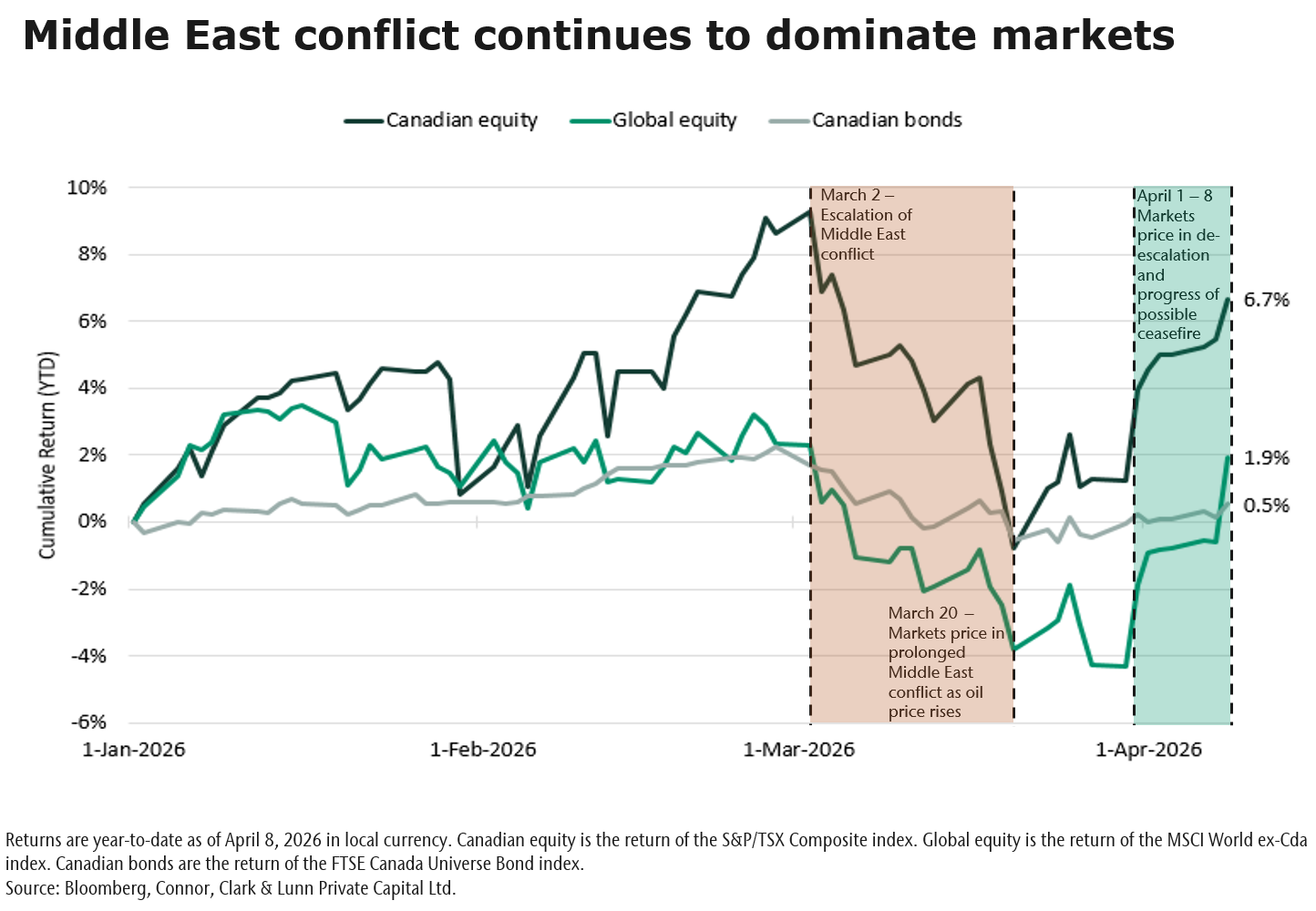
Markets are increasingly being shaped by developments in the Middle East, with the recent ceasefire offering only modest reassurance. While the pause in hostilities is directionally positive, it remains fragile, with reported violations and no clear resolution around key oil shipping routes. As a result, energy markets continue to reflect the risk of disruption, keeping oil prices elevated and uncertainty front of mind for investors.
Duration is key
What matters most for markets is not simply that a conflict is occurring—but how it evolves from here. History suggests that markets tend to look through geopolitical events when they are short-lived. However, when conflicts persist or escalate, the impact becomes more meaningful and longer-lasting. The duration and scope of the conflict will be critical in determining whether it remains a temporary source of volatility or develops into a broader macroeconomic headwind.
Energy is the key transmission channel. Sustained pressure on oil prices has the potential to feed into inflation, which in turn influences central bank policy and interest rates. While long-term inflation expectations remain relatively well anchored, the direction of travel bears watching. Even a modest reacceleration in inflation could limit the ability of central banks to ease policy, particularly at a time when growth is already showing signs of moderating.
A more reactive market environment
This dynamic is contributing to a shift in market behavior. Rather than trending steadily in one direction, equities have become more reactive to news flow, pulling back on uncertainty and rallying sharply on incremental signs of de-escalation. The result is a more uneven path for returns, even as overall market levels have held up reasonably well. In practical terms, markets are oscillating between concern and relief, rather than expressing a strong, sustained view.
Against this backdrop, equity valuations remain an important consideration. While headline multiples are elevated relative to long-term averages—particularly in the United States—they are supported by a backdrop of still-resilient earnings and a global economy that continues to expand. At the same time, investors are becoming more cautious and seeking a higher return for risks taken; this is something we see reflected in higher expected returns for equities. This suggests a more balanced environment: one where markets are not stretched to extremes, and where returns may be more dependent on how macro risks evolve.
The key takeaway is that markets have shown resilience, but the path forward is likely to be less smooth. A scenario where the conflict stabilizes and energy markets normalize would allow investors to refocus on fundamentals, including earnings growth and improving breadth in market leadership. Conversely, a more prolonged disruption—particularly one that keeps oil prices elevated—would reinforce inflation pressures and create a more challenging backdrop for both equities and bonds.
The bottom line
For now, the most likely outcome sits somewhere in between. Markets are not ignoring the risks, but neither are they pricing in a worst-case scenario. This creates an environment where flexibility and diversification remain essential. Periods of uncertainty can lead to short-term volatility, but they also tend to create opportunities as sentiment shifts. For markets, the key concern isn’t the conflict itself—it’s whether it fades quickly or becomes a more persistent source of pressure.