March 27, 2026
315305db-0cbd-4607-907b-dd3371e5ded8.png?sfvrsn=6c5a115f_1 "Insights post image - 844 x 563px (1)")
Key takeaways
- Oil is the dominant market driver: Supply disruptions have pushed prices higher, reinforcing inflation pressures and delaying expected rate cuts.
- Diversification is being tested: Bonds and traditional hedges are providing less consistent protection, particularly during equity drawdowns.
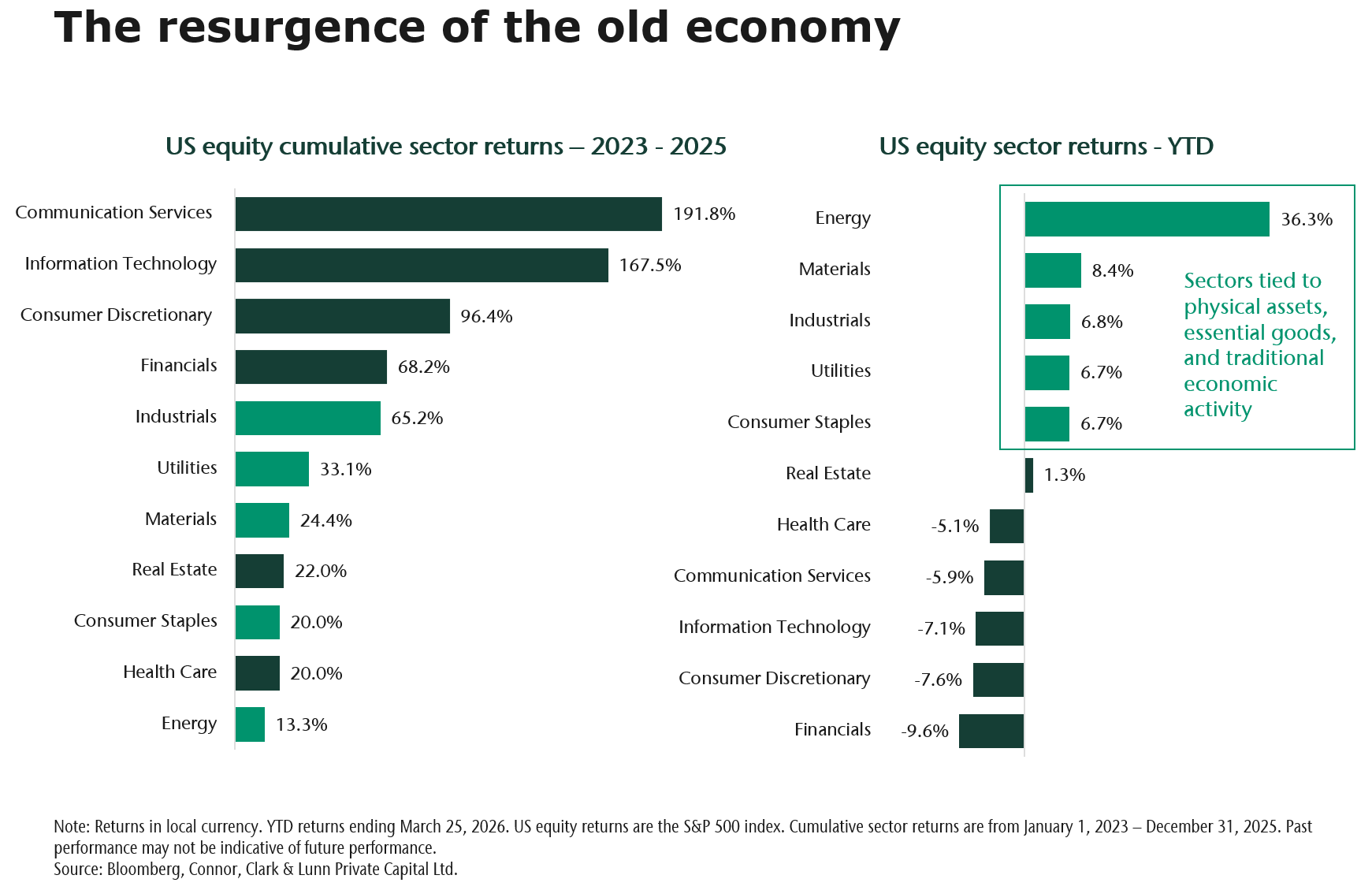
- A clear rotation is underway: Leadership has shifted from “new economy” tech toward “old economy” sectors with tangible assets, pricing power, and resilient cash flows.
The events unfolding in the Middle East remain deeply concerning from a humanitarian perspective. For markets, the impact has been a sharp increase in uncertainty, driven primarily by the risk of prolonged disruption to global energy supply. While geopolitical shocks are not unusual, what has made this episode particularly noteworthy is its direct link to oil markets and, by extension, inflation and monetary policy expectations.
Oil as the dominant driver
The most important development in March has been the surge in oil prices. The effective disruption of shipping through the Strait of Hormuz — a critical artery for roughly 20% of global oil supply — has created a meaningful supply shock. The magnitude of the move in oil prices is significant not just for energy markets, but for the broader macroeconomic backdrop too. Higher oil prices act as a tax on consumers, raise input costs for businesses, and tend to push headline inflation higher.
This dynamic explains why both equities and bonds have struggled simultaneously. Equity markets are discounting slower growth and tighter financial conditions, while bond markets are adjusting to the risk that central banks may need to keep policy rates higher for longer.
Traditional market hedges are losing effectiveness
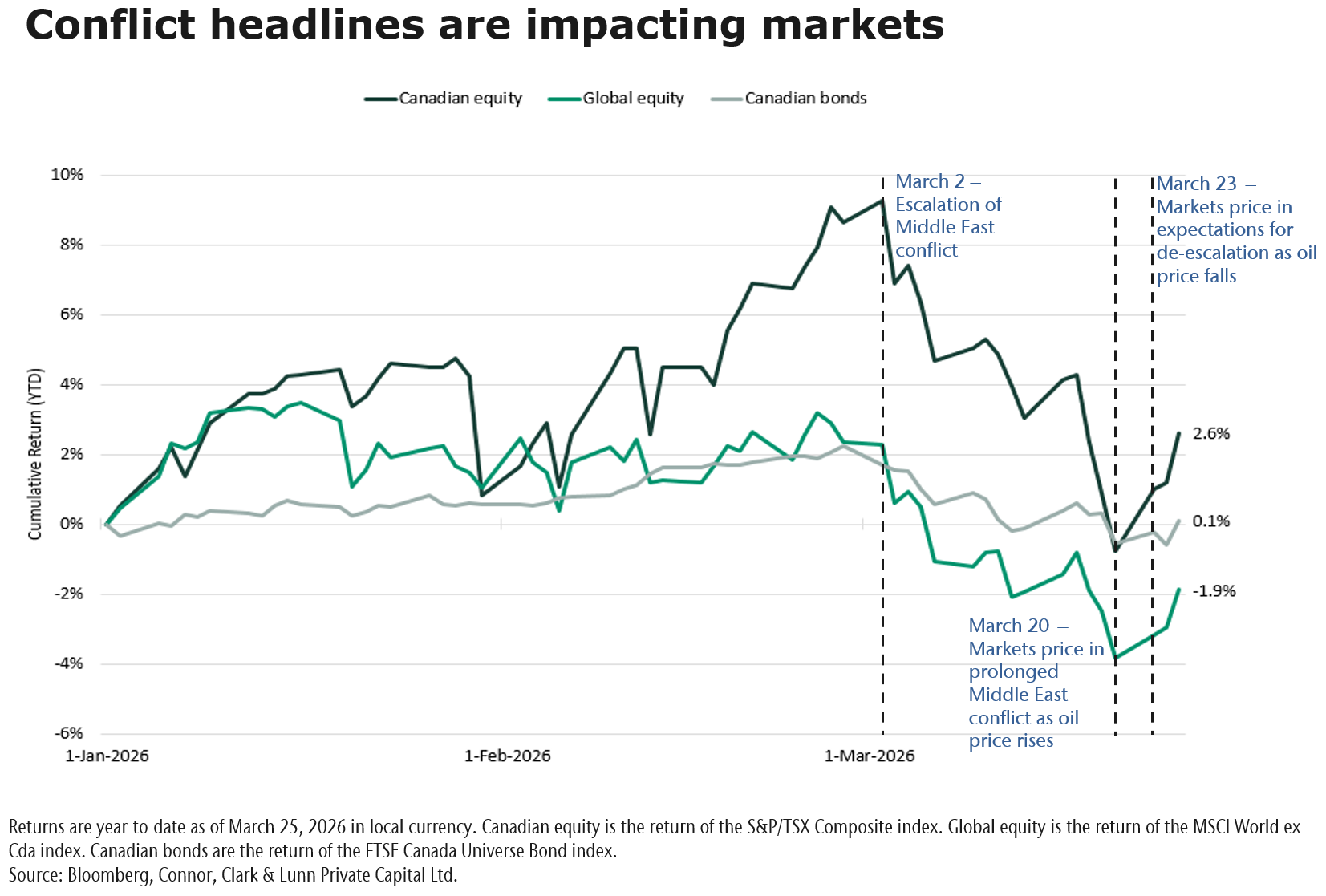
Over the past month, markets have experienced pronounced swings across asset classes as investors attempt to assess both the duration of the conflict and its broader economic consequences. Despite the volatility, global equity markets have declined only 1.9% year-to-date. Assets long viewed as portfolio hedges—such as bonds and gold—have become less reliable during periods of equity stress.
Bonds once provided consistent ballast. In 2011, the United States (US) Aggregate Bond Index rose about 80% of the time the stock market experienced down days. That relationship has weakened materially. In 2025, bonds were positive in only about 45% of those sessions. The takeaway: diversification still works—just less consistently when it is most needed.
Old economy > new economy
We have experienced a prolonged period of dominance by technology and other “new economy” sectors—businesses driven by software, data, and other intangible assets with scalable, asset-light models. Now, there are emerging signs of a shift in market leadership. Valuation dispersion across equities appears to be narrowing, with renewed momentum in traditionally overlooked, “old economy” sectors such as consumer staples, materials, and energy. These are areas characterized by tangible assets, durable cash flows, and resilience in weaker economic environments.
This rotation is occurring alongside a notable re-rating in technology, where concerns around Artificial Intelligence (AI) spending, disruption risks, and elevated expectations have led to a meaningful pullback. The “Magnificent Seven”, for example, have declined, compressing valuation premiums to their lowest levels in years and bringing technology multiples back toward historical norms. While the long-term growth outlook for technology remains intact, the near-term environment reflects a more balanced market, where investors are increasingly rewarding cash flow stability and pricing power; looking beyond “big tech” to a broader set of opportunities across the “real economy.”
Portfolio positioning: measured adjustments, not broad shifts
In volatile markets dominated by political headlines, making big shifts in portfolio positioning carries substantial risk. Predicting the timing of a macroeconomic resolution or a sudden reversal in market leadership is exceedingly difficult.
Our approach to navigating this environment has remained disciplined and grounded in observable economic trends rather than geopolitical speculation. We do not attempt to predict the path of the conflict. Instead, we assess how developments are influencing inflation, interest rates, and cross-asset behaviour, and adjust portfolios accordingly.
Within equities, we have made modest adjustments to reflect the changing backdrop. In Canadian equity portfolios, this has included increasing exposure to integrated energy companies and pipeline operators that may benefit from sustained higher oil prices. At the same time, we have reduced exposure to more economically sensitive cyclicals and shifted toward businesses with more stable earnings profiles.
At the total portfolio level, we continue to maintain a cautious stance toward traditional long-duration bonds. Rising yields have reinforced our preference for shorter-duration, higher-yielding global bonds and mortgages, which provide income while limiting sensitivity to further increases in interest rates.
We also maintain exposure to a market-neutral strategy designed to perform independently of the direction of interest rates. This allocation has been funded from traditional fixed income and has helped offset some of the pressure from rising yields. So far this year, this approach has been effective in improving portfolio resilience.
Importantly, we entered this period with a balanced risk posture. We were not positioned aggressively for a risk-on environment, which has allowed us to navigate recent volatility without the need for significant repositioning.
Volatility driven by uncertainty, not fundamentals (yet)
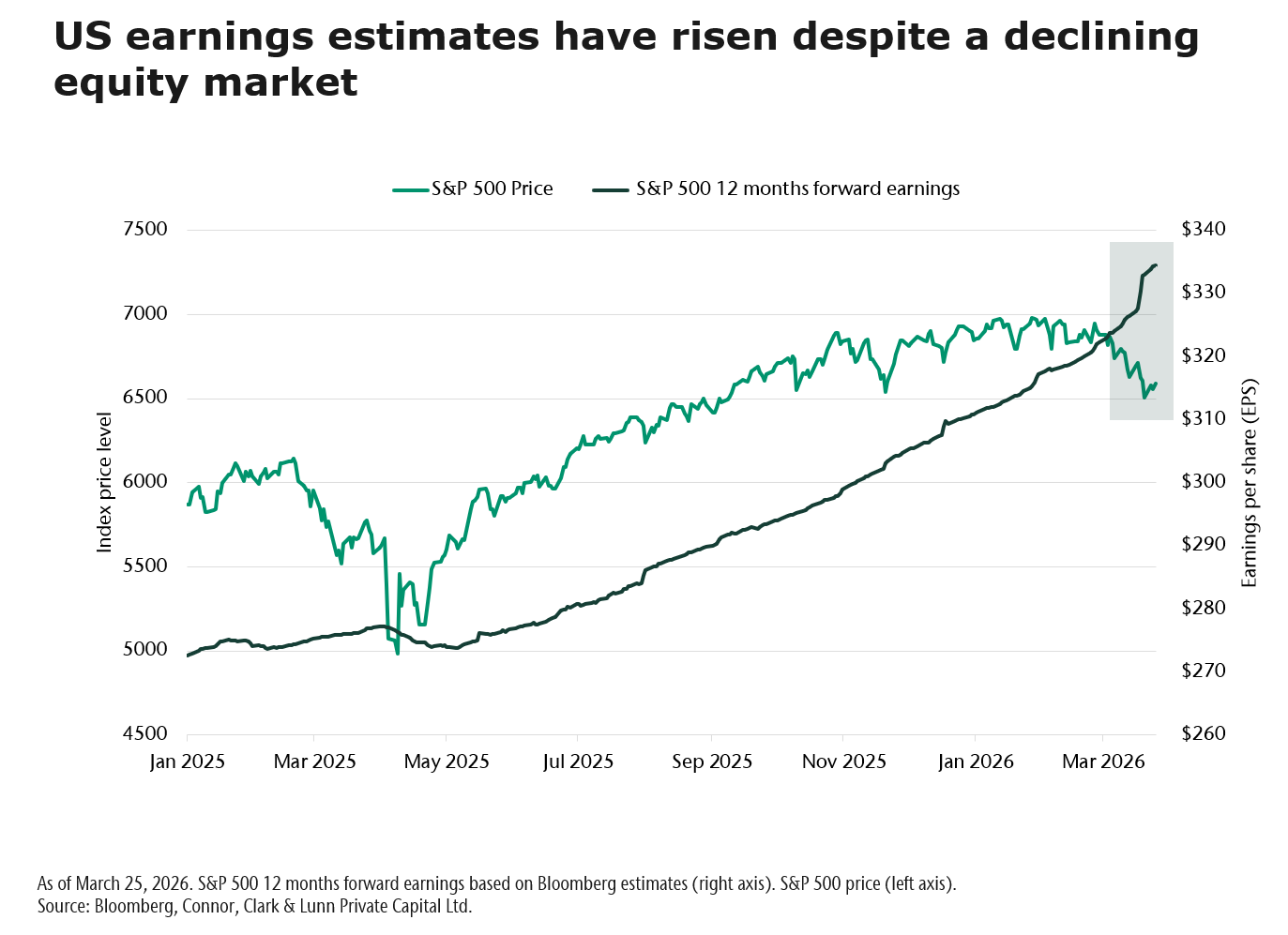
Despite the sharp moves in energy and the increase in volatility, the underlying economic backdrop has not yet deteriorated meaningfully. What's particularly notable is that consensus US earnings estimates have risen over the last two months as the S&P 500 has steadily fallen. Does that signal an unjustifiably optimistic outlook for US corporates, or an overly gloomy market reaction to the external environment? The answer depends on the duration and magnitude of the conflict. Across a range of potential outcomes, our portfolios are allocated to weather the near-term uncertainty while positioning for the eventual return to “normal” – if that term is still applicable in this day and age.
Historical context: short-term pain, longer-term resilience
Markets have historically been challenged in periods of rising oil prices. Higher energy costs tend to weigh on sentiment, compress margins, and introduce uncertainty into economic forecasts. Over the past several months, returns have largely been muted as markets digest the shock.
However, the longer-term picture has generally been more constructive. As economies adjust and supply constraints ease, markets tend to stabilize and refocus on underlying drivers such as earnings growth and policy conditions. Historically, equity markets have often been higher twelve months after similar oil shocks. This suggests that while these episodes can interrupt momentum, they do not typically derail broader market cycles.
This historical perspective is important in framing the current environment. While volatility may persist in the near term, it does not necessarily imply a structural change in the outlook.
Central banks: back to inflation vigilance
Another key development has been the shift in central bank tone. The rise in energy prices has reintroduced inflation as a primary concern, delaying expectations for rate cuts. While policymakers remain in wait-and-see mode, the bar for easing policy has clearly increased. The critical question is whether higher energy prices feed through into broader inflation measures, particularly wages and core inflation. If they do, central banks may be forced to respond more aggressively. If not, they may look through the shock as a temporary supply-driven event. For now, markets are adjusting to a scenario in which interest rates remain higher for longer.
The bottom line
Markets are navigating a period of heightened uncertainty, with oil prices acting as the central driver of both volatility and macroeconomic risk. While recent moves across equities, bonds, and commodities have been significant, they are primarily a reflection of rising uncertainty rather than a confirmed deterioration in fundamentals.
The path forward will depend on the duration of the energy disruption and its impact on inflation and growth. A shorter-lived shock would likely allow markets to stabilize and refocus on earnings and economic resilience. A more prolonged disruption would present a greater challenge, which would likely lead to a further market decline and a longer recovery.
In this environment, maintaining discipline is essential. Rather than reacting to headlines, we continue to position portfolios to balance resilience with long-term opportunity. Diversification, selective adjustments, and a focus on underlying economic trends remain the appropriate approach as markets work through this period of uncertainty.