February 27, 2026

Key takeaways
- AI is being recalibrated: From hyperscalers to software, AI-linked stocks are being repriced as investors demand clearer returns on rising capital spending and reassess long-term disruption risks.
- Market leadership is broadening: Capital is rotating away from concentrated, AI-sensitive mega-caps toward areas of the market less tied to the AI theme.
- Tariff risk appears manageable: The recent ruling was largely anticipated, and while trade policy remains fluid, markets currently view the economic impact as incremental rather than material.
February was defined by a shift in leadership beneath the surface of global markets. While economic fundamentals remained broadly stable, volatility within Artificial Intelligence (AI)-linked equities intensified. In addition, trade policy re-emerged as a source of uncertainty following a significant United States (US) Supreme Court ruling on tariffs. Together, these forces reflect a market that remains healthy overall but unsettled in the near term.
The AI disruption story
Hyperscaler AI investment expectations have moved sharply higher in recent weeks. Current 2026 capital expenditure forecasts have risen from approximately $592 billion to $737 billion (USD)— a 25% upward revision. This represents a material acceleration in anticipated spending and meaningfully raises the revenue and monetization hurdle required to generate attractive returns on that investment.
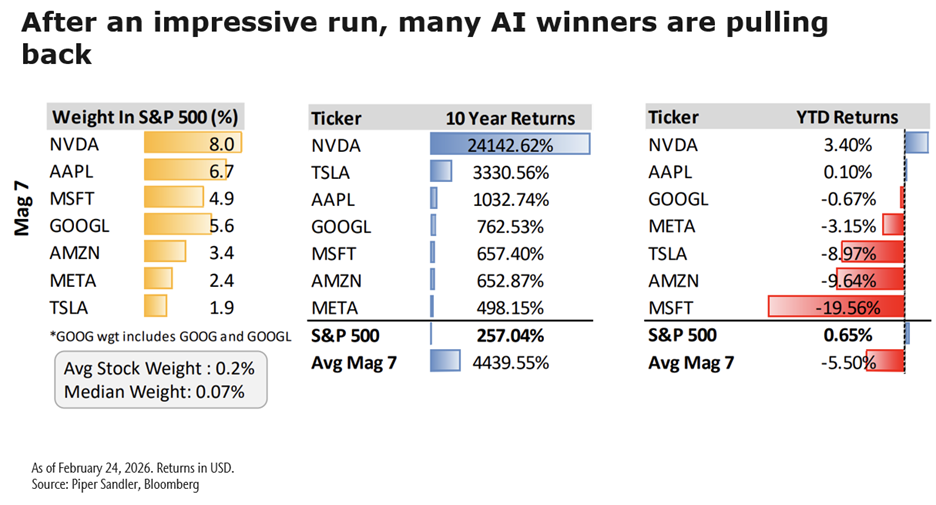
Importantly, this sharp increase in expected spending has occurred at the same time that hyperscaler stocks have declined. Despite the increased long-term commitment to AI infrastructure, several of the largest platform companies’ share prices have declined year-to-date, with Microsoft down approximately 20%. Markets appear increasingly focused not on whether AI investment will occur, but on the timing and magnitude of the returns required to justify it. As capital spending rises, valuation sensitivity increases.
As a result of their significant weight within the S&P 500, weakness in these mega-cap AI leaders is now having an outsized impact at the index level. After driving a substantial portion of market returns over the past decade, the “Magnificent 7” are no longer lifting the benchmark, they are dragging it down.
AI selectivity and portfolio positioning
This dynamic reinforces a broader shift underway within technology. Leadership is no longer uniform across AI-linked segments. The shift within US technology has been sharp. Semiconductor companies — which are directly tied to current AI infrastructure spending — have outperformed, while software companies have lagged as investors question how durable their competitive positions will be. In effect, the market has moved from rewarding AI exposure broadly to differentiating between near-term revenue beneficiaries and businesses facing potential structural disruption.
Given the speed of this shift and continued weakness across software and business services, we have reduced our portfolio exposure to manage downside risk. Selectivity within AI remains critical. The opportunity is significant, but the range of outcomes is widening.
Market leadership is broadening
There has been a clear rotation out of concentrated AI hyperscaler exposures and into areas of the market with lower correlation to AI — sectors that can perform well under the current macroeconomic backdrop. Energy, capital goods, and materials have all benefited from this shift. As active managers reduce exposure to near-term AI volatility, capital is flowing toward businesses tied to commodity demand, industrial investment, and more traditional economic cycles.
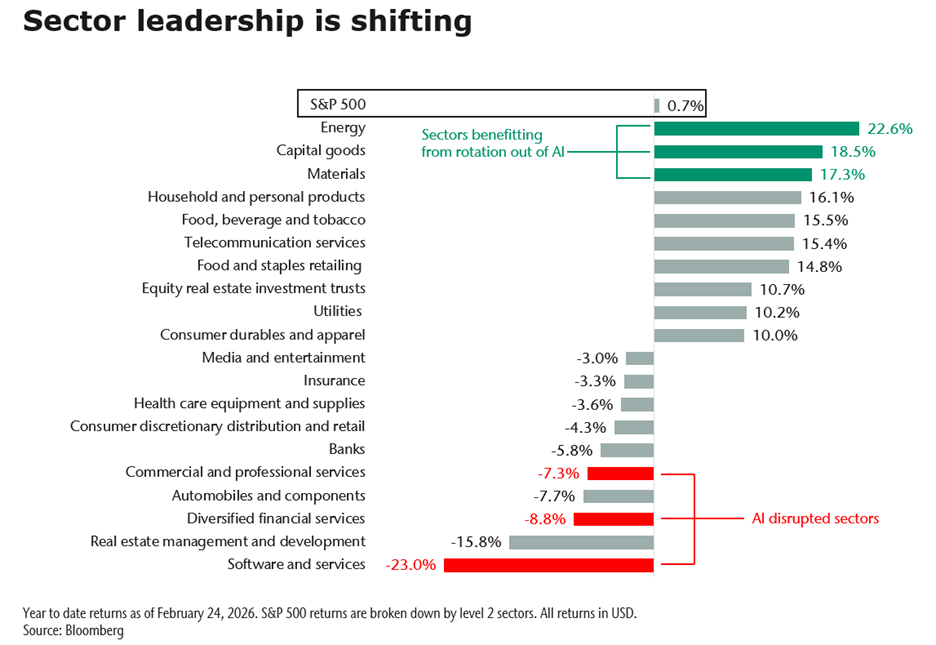
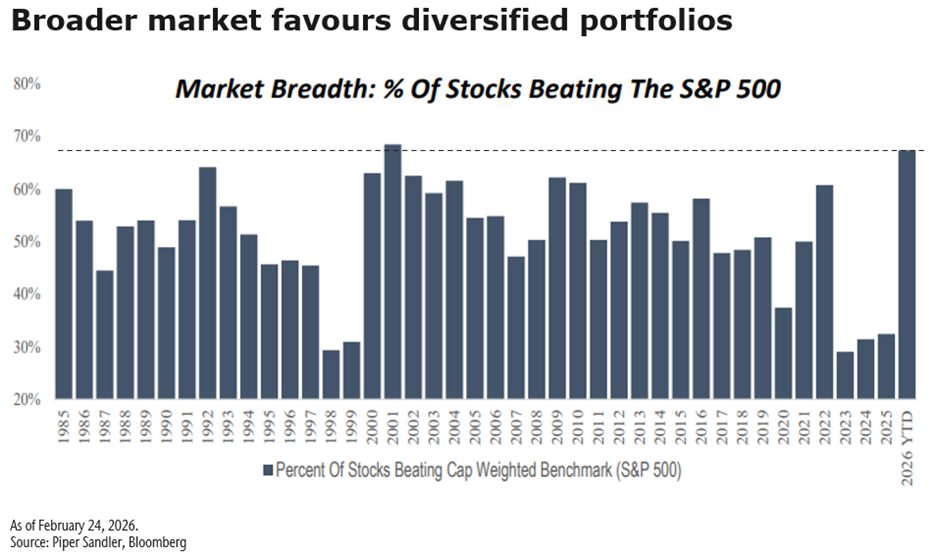
This rotation is helping offset weakness in AI-sensitive areas. While headline indices may appear relatively stable, there are significant moves occurring across index constituents. Market breadth has improved, with a rising percentage of stocks outperforming the broader index. This is a healthy development after a period of extreme concentration.
Performance differences have widened across regions and market capitalizations. Small caps and emerging markets have performed well, while Canada and other international markets have outpaced the more AI-heavy US market. In short, weakness in AI-linked names has been offset by strength elsewhere as leadership shifts.
US tariff ruling: limited market impact
The US Supreme Court’s decision to strike down broad US tariffs has been positive but has had a muted market impact. Investors had already assigned a reasonable probability to a legal setback, and so far, markets are treating the announcement — and the President’s stated intention to pursue a 10%-15% tariff — as an incremental development rather than a material shift in the economic outlook.
Initial estimates suggest the average effective US tariff rate could fall roughly in half. The proposed replacement tariffs are currently temporary, with pathways to extend or modify them over time, though doing so would require additional legal or congressional action. In the chart below we illustrate the changes for major economies globally.
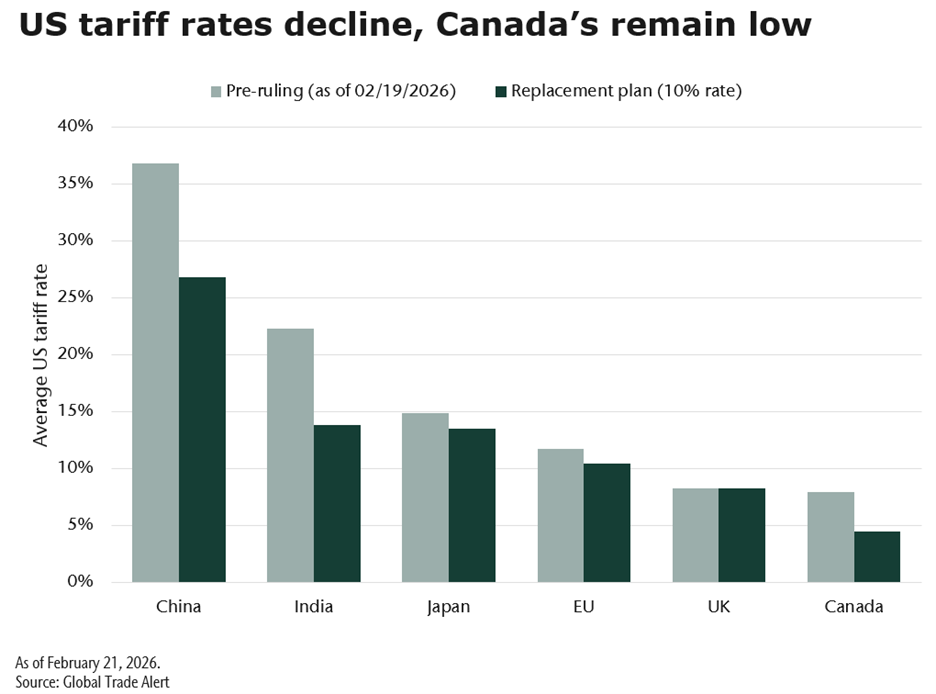
For Canada the impact is modest. Goods compliant with the US-Mexico-Canada Agreement (USMCA) were already largely exempt. More importantly, sectoral tariffs — covering steel, aluminum, autos, lumber, copper and related goods — remain in place. These are economically more significant and continue to negatively impact these industries.
Over the last year, we have experienced periods of elevated tariffs with only modest effects on growth and inflation. That said, US trade policy remains fluid, making the ultimate economic impact difficult to assess. While there are alternative legal paths to implement tariffs, their scope, duration and political sustainability are uncertain.
The bottom line
At a high level, markets are recalibrating — not unraveling. AI remains a powerful structural theme, but investors are demanding clearer evidence of returns as capital spending accelerates. That shift is creating volatility in the largest technology stocks, while at the same time broadening opportunity across sectors, regions and market capitalizations. Leadership is becoming more balanced, which is healthy after years of concentration, but it requires greater selectivity and discipline.
Against this backdrop, diversification matters more than ever. We are navigating a market that remains constructive overall but unsettled in the near term. Our global large cap portfolio remains overweight AI, though we have become more selective and have reduced that overweight in recent months — trimming hyperscalers and AI infrastructure companies as capital spending rises and return uncertainty increases. Importantly, our long-term view is unchanged. AI continues to represent a powerful structural driver of productivity and earnings growth; the current repricing reflects questions of timing and return thresholds, not a reversal of the theme itself.
The team has also been cutting software and business services more meaningfully as they face greater disruption risk and no longer act defensively. Proceeds have been reallocated to lower-correlation areas tied to more traditional economic drivers. This includes energy, utilities and power; industrials and capital goods; and select defensive compounders, such as telecom. The objective is to reduce concentration risk and position the portfolio to participate in a broader set of return drivers, rather than relying on a narrow group of AI leaders.