March 19, 2026
3378fbc6-6ea5-451f-afbe-52cabd364c5a.png?sfvrsn=9e0fbb95_1 "Insights post image - 844 x 563px (1)")
The way women approach investing is shaped by factors unique to their experiences, from career transitions and caregiving roles to sudden life changes, longer lifespans and the desire to leave a legacy. Understanding and addressing these is essential to ensure that women are empowered to create and sustain wealth. At CC&L Private Capital, we provide full-service, female-tailored investment advisory services that support women at every stage of their wealth creation journeys.
Distinctive characteristics of women in investing
For many women, investing also intersects with profound life transitions—such as the dissolution of a marriage, the death of a partner—moments that can bring both emotional complexity and the need for renewed financial confidence. Against this backdrop, there is often a strong desire not only for security and independence, but also to build a meaningful legacy that reflects their values and supports those they care about most.
Women’s financial decision‑making is often shaped by pivotal life events, with performance evaluated in terms of how effectively it supports real‑world outcomes rather than investment returns alone. Research suggests many women are more risk averse and tend to have lower financial self-confidence than men. In addition, women usually have many different financial concerns to men. These involve changes to income and spending levels following the death or divorce of a partner, leaving a legacy for their family, and being a financial burden in old age (which can be more likely for women given interrupted careers and longer life expectancy). Fortunately, studies have observed that women tend to be open to improving their financial literacy, and that they are more disciplined 1, and more likely to seek professional advice than their male counterparts.2 This makes women particularly good long-term planners and investors.
Time is the most powerful investment partner
Financial literacy is key to fostering sound saving and spending habits; understanding how these habits can compound over time is essential for one’s success. For instance, waiting 10 years to start investing doesn’t delay results by 10 years. In fact, it can cut materially reduce long-term outcome. In the table below, we have illustrated what an investor might expect when they retired at age 65 if they invested $6,000 at end of each year, in a non-taxable investment account, starting at different ages.
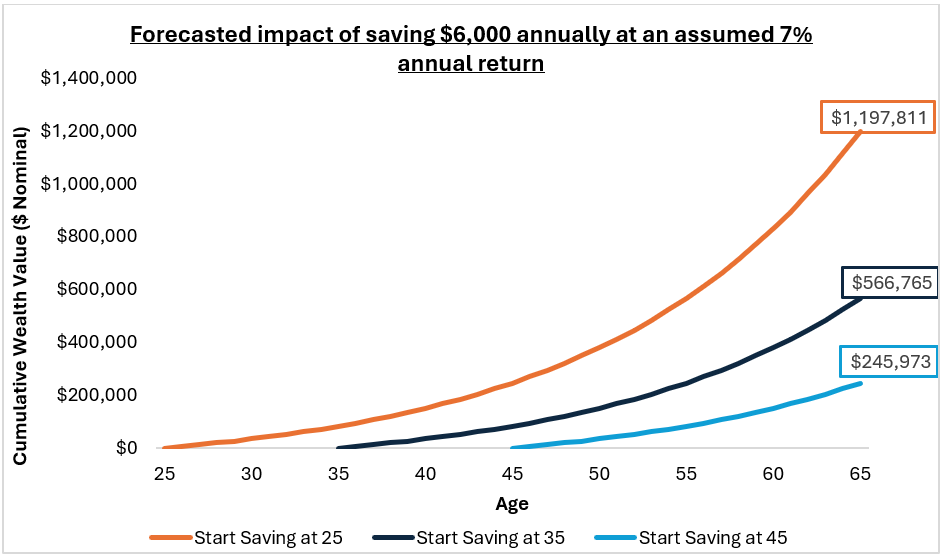
In this way, we see consistency, and small decisions can amount to very different outcomes over time. The earlier you invest, the harder your capital works – and the greater the rewards you reap. That being said, other priorities can make it difficult to start saving early; and the best time to invest for your future is always “today”. Research suggests women tend to be more disciplined savers than men.1
An education in diversification
An education in appropriate diversification can help women to feel more comfortable taking on the level of investment risk necessary to realize their financial objectives. Different asset classes have various associated return and volatility profiles. While medium-term investments require a more conservative strategy, and are often restricted to traditional asset classes, those investment goals with at least a 10-20-year time horizon can benefit greatly from investing in alternative asset classes and investment strategies.
For instance, alternative assets like real estate, infrastructure, and private loans are less exposed to the kind of economic factors that influence the movements of stocks and bonds and thus offer another source of returns with relatively low volatility. While they have lower liquidity—and therefore require longer investment horizons—we carefully manage this within our pooled funds structure.
Another example is small-cap stocks, which offer the potential for higher returns due to their growth-oriented nature and agility in adapting to market changes. These stocks are also often undervalued and overlooked by institutional investors—many of whom are not mandated to invest in this segment of the market. While investing in small cap stocks on its own can be quite risky, within a recommended asset allocation of 8-10%, it can help diversify risk and increase returns over the long term.
CC&L Private Capital’s premier investment platform

While women are typically more risk-averse than men—and thus tend to place a stronger emphasis on avoiding investment losses—being effectively educated on the role and characteristics of the various asset classes can empower women to make informed decisions about their investments. CC&L Private Capital’s investment plans reflect historical drawdowns and forecasted probabilities of decline so as to ensure clients are informed about and comfortable with market fluctuations in the pursuit of long-term returns. This goes a long way to helping female investors weather the vagaries of the market and ensure they remain confident regarding the level of risk they are taking to achieve the desired long-term returns.
Conclusion
CC&L Private Capital’s female focused wealth management experience is designed to give you the clarity, confidence, and control necessary to realise your financial aspirations. Our investment advisory approach is tailored to women’s investment journeys and designed to meet the unique challenges they face. Fill in the form below to learn how our Wealth Advisors can help you navigate changeable markets with confidence and realize the goals that matter most to you and your family.