
Smart retirement spending: Understanding core and excess capital

January 20, 2026

While many people have an idea of how much they would like to spend each year during retirement, they feel uncertain about whether their portfolio can sustain it and wrestle with other spending priorities. Can I help my children with a down payment on their first home? Can I make a sizeable donation to charity? Will doing so compromise my lifestyle in retirement? Understanding the difference between core and excess capital can guide you in answering such questions.

What is core capital?

Core capital is the wealth an investor needs now to fund future retirement expenses with a high degree of confidence (typically with a 90% probability). Core capital represents the essential assets required to sustain your lifestyle over a chosen time horizon, such as retirement.

What is excess capital?

For those with wealth beyond their means, excess capital is the amount currently available that is not required to support key future spending goals. Excess capital serves as a buffer, offering flexibility for discretionary purposes such as large additional purchases, philanthropy, and legacy planning. 

How to calculate core and excess capital

Consider a 65-year-old retiree in British Columbia, who expects to live for another 25 years. The retiree has $3 million invested in a personal taxable account (balanced investment strategy). Going forward, the retiree would like to spend $100,000 annually after-tax, grown for inflation. Assuming the portfolio is their only source of income, a custom CC&L Private Capital analysis suggests that they would require $2.2 million invested today.

A CC&L Private Capital balanced investment portfolio is typically comprised of 32% fixed income, 13% hedge strategies, and 55% equities (long-term target weights). With $2.2 million invested in such a strategy, our forecasts suggest with a reasonably high degree of confidence that the retiree will not run out of capital in their lifetime (by age 90). Therefore, we consider the remaining $800,000 (of their $3 million in investment assets) to be excess capital. 

Core vs. Excess Capital ($ millions)1
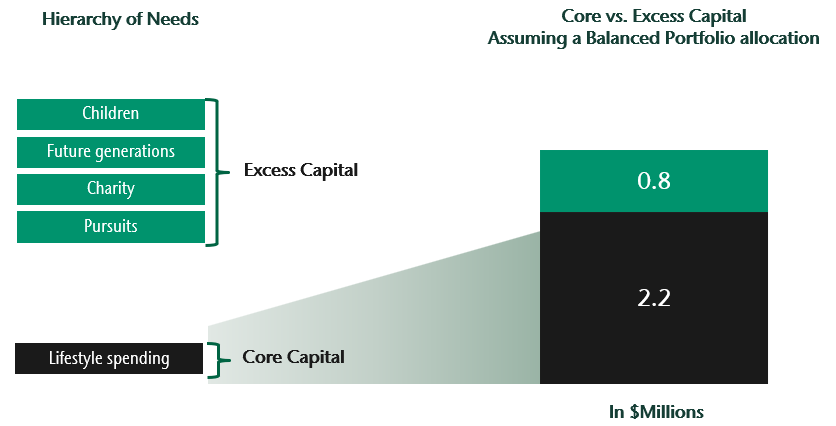
Core Capital, in this example, is the forecasted level of investment assets required today to meet spending needs of $100,000 net annually, plus 2.4% inflation, over the next 25 years with a 90% level of confidence. All amounts are in Canadian dollars and do not include management fees. Analysis is based on estimates of the range of returns for the applicable capital markets using CC&L Private Capital forecasts as of February 29, 2024 market conditions. Data does not represent past performance and is not a promise or guarantee of actual or range of future results. Source: CC&L Private Capital.  

Determining your essential and discretionary retirement funds

Your anticipated spending level and time horizon are amongst the key variables in calculating core and excess capital. The following table illustrates core capital requirements for various spending rates and time frames using CC&L Private Capital forecasts and a balanced asset mix. While this information can be a helpful guideline, it does not replace a custom analysis that considers changes in asset mix, account types, outside income sources, and unique tax situations.

Core Capital Requirements ($Millions)2
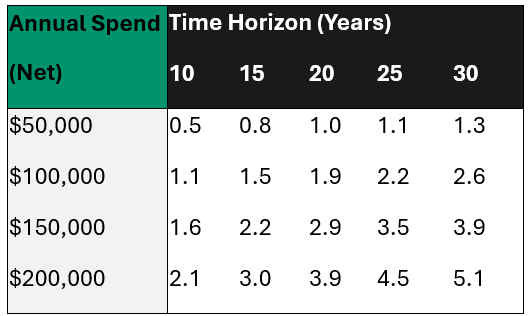
Assumes a CC&L Private Capital balanced investment portfolio, personal taxable account (B.C. jurisdiction), no outside income, spending indexed for 2.4% inflation. Based on estimates of the range of returns for the applicable capital markets using CC&L Private Capital forecasts as of February 29, 2024 market conditions. All amounts are in Canadian dollars and do not include management fees. Data does not represent past performance and is not a promise or guarantee of actual or range of future results. Source: CC&L Private Capital.  

Core and excess capital values are based on calculations and forecasts of future investment performance that can never be 100% certain. However, at CC&L Private Capital, we can estimate clients' core and excess capital with a high degree of confidence, such that the core capital amount will be able to sustain clients' planned spending over the given time horizon —even if financial markets perform poorly. 

We simulate 1,000 potential investment return scenarios, looking for a core capital amount that provides adequate resources in at least 900 of those scenarios. This gives us the high degree of confidence necessary to enable our clients to feel confident in their chosen investment strategy. Those conservative clients who wish for an even higher degree of confidence are accommodated by utilizing a higher level of core capital.

Factors influencing core and excess capital calculations for retirement planning

Many high-net-worth individuals receive rental income, part-time consulting fees, work pensions, and / or government benefits during retirement. These incomes can offset annual spending needs and therefore reduce core capital. 

For instance, suppose the 65-year-old retiree in our example receives $20,000 annually in pre-tax pension benefits (indexed for inflation). In this case, their core capital would decrease from $2.2 million to $1.9 million as the required draw from their investments is smaller.

Additionally, tax rules and return expectations vary across asset classes and account types. RRSP withdrawals, for example, are subject to withholding tax, unlike distributions from other account types. Therefore, retirees with a high proportion of retirement savings in registered accounts may have higher core capital requirements due to larger tax obligations. 

Conclusion

Understanding your core and excess capital helps you determine the investment strategy most appropriate for you and helps you to make better-informed investment decisions. Core capital calculations reveal what you need for future expenses; while identifying excess capital enables you to confidently spend or bequeath funds today. Fill in the form below to speak to one of our Wealth Advisors and learn more about your core and excess capital.


Disclaimer

This material, including any attachments, is provided for informational purposes only. This material is intended for the use of the recipient only and no matter contained herein may be separately used, disseminated, distributed, reproduced or copied by any means, in whole or in part without express prior written consent of Connor, Clark & Lunn Private Capital Ltd. (“CC&L Private Capital”). Certain information contained herein is based on information obtained from third-party sources that CC&L Private Capital considers to be reliable. Past performance is not a guide to future performance, future returns are not guaranteed, and a loss of capital may occur. All opinions, estimates and projections contained in this material constitute CC&L Private Capital’s judgment as of the date of this material, and are subject to change without notice. This material has been prepared without regard to the particular individual financial circumstances and objectives of persons who receive it and nothing in this material constitutes legal, accounting, tax or individually tailored investment advice. Readers should consult with independent professionals regarding their individual circumstances, as applicable. This information is not an offer to sell or a solicitation of an offer to buy any securities and is not to be used as a sales communication.

Hypothetical returns & portfolio characteristics

The CC&L Private Capital Suggested Simulated Portfolio investment returns and portfolio characteristics are hypothetical and do not represent actual performance or the portfolio characteristics of the strategy as components of the strategy (eg. Private Loan Portfolio) have not been existence for the entire performance period and since we have assumed that you would be fully invested in the strategy at the outset, when you may only be invested in components of the strategy (eg. Private Loan, Real Estate and Infrastructure Portfolios) when those components open for investment. Where shown, hypothetical performance results and portfolio characteristics have certain inherent limitations. Hypothetical returns and portfolio characteristics are designed with the benefit of hindsight. Calculations are based on assumptions, including market conditions and investment strategies, which may not reflect real-world scenarios accurately. Hypothetical returns and component portfolio characteristics do not consider taxes, fees or other transactions costs that may impact actual investment performance. No representation or guarantee is being made that any account will or is likely to achieve returns or portfolio characteristics similar to those shown above. Although the blended returns and portfolio characteristics shown are hypothetical, the component returns and component portfolio characteristics are actual and there is no guarantee that the component returns nor the component portfolio characteristics of the CC&L Private Capital Suggested Simulated Portfolio will in the future achieve returns similar to their historical performance or portfolio characteristics similar to their historical portfolio characteristics. The past performance of each component return is not a guide to future performance. The actual component returns and portfolio characteristics used in the hypothetical return and hypothetical portfolio characteristics calculations are the composite returns and characteristics maintained for each of the asset classes used in the backtest. The hypothetical portfolio returns and characteristics and the actual component returns and characteristics are gross of fund operating expenses including but not limited to expenses such as custody, audit, and valuation.

The calculation of the hypothetical portfolio and benchmark returns is done by geometrically linking weighted average monthly returns in order to calculate hypothetical annual and annualized returns. The performance calculations assume that the portfolio and benchmark weights are unchanged during the time period shown. Hypothetical returns and portfolio characteristics also assume that asset allocations would not have changed over time in response to market conditions, which might have occurred if an actual portfolio had been actively managed during the time period shown. Variations from the target weights or differences in the timing or rebalancing the target asset weights could have a material impact on the annualized performance returns or portfolio characteristics delivered by the hypothetical performance backtest The backtest assumes that the account would have been fully invested in all asset classes (including real estate and infrastructure) over the entire simulation or backtest period, including the re-investment of all distributions out of the component returns used in the backtest. Any client experience will necessarily be different as any allocation to the asset classes that hold real assets (real estate and infrastructure) will be deployed over time and any client investment will not be fully deployed to these asset classes at the inception/funding of the account. Most investors receive their distributions from real estate and infrastructure in cash which is not re-invested in those strategies automatically. If you wish to receive information on hypothetical returns and portfolio characteristics for different time periods or for different asset mix weightings, please feel free to contact CC&L Private Capital. This is for informational purposes only and is not intended as investment, financial, tax, legal or accounting advice and should not be considered a recommendation to buy, sell, or hold any securities or investments.This is for informational purposes only and is not intended as investment, financial, tax, legal or accounting advice and should not be considered a recommendation to buy, sell, or hold any securities or investments.

The specified form no longer exists or is currently unpublished.

Catherine Dorazio
Managing Director
Business Development

Loading animation
Your Details

Let's stay connected

Subscribe to receive our quarterly email update and stay connected with everything new that's happening at CC&L Private Capital.