November 27, 2026

Key takeaways
- Growing uncertainty around the AI investment cycle accelerated the unwinding of crowded investments in November, even as underlying demand and earnings remain strong.
- Economic growth continues to exceed expectations, supporting corporate earnings but keeping inflation and interest rates elevated.
- Lower equity valuations, higher bond yields and a prospect of more sustainable economic growth are creating a more balanced investment opportunity set heading into 2027.
The unwinding of the artificial intelligence (AI) trade that began in June accelerated in November as new sources of uncertainty emerged. The United States (US) midterm election raised the risk of restrictions on data centre development, while Nvidia's leadership turmoil exposed the risks of relying too heavily on a single company. Even Anthropic's record-breaking IPO failed to reignite enthusiasm for AI stocks. After several years of exceptional returns, heavy investor exposure to the theme left AI-related stocks particularly vulnerable to selling as investors reduced their exposure.
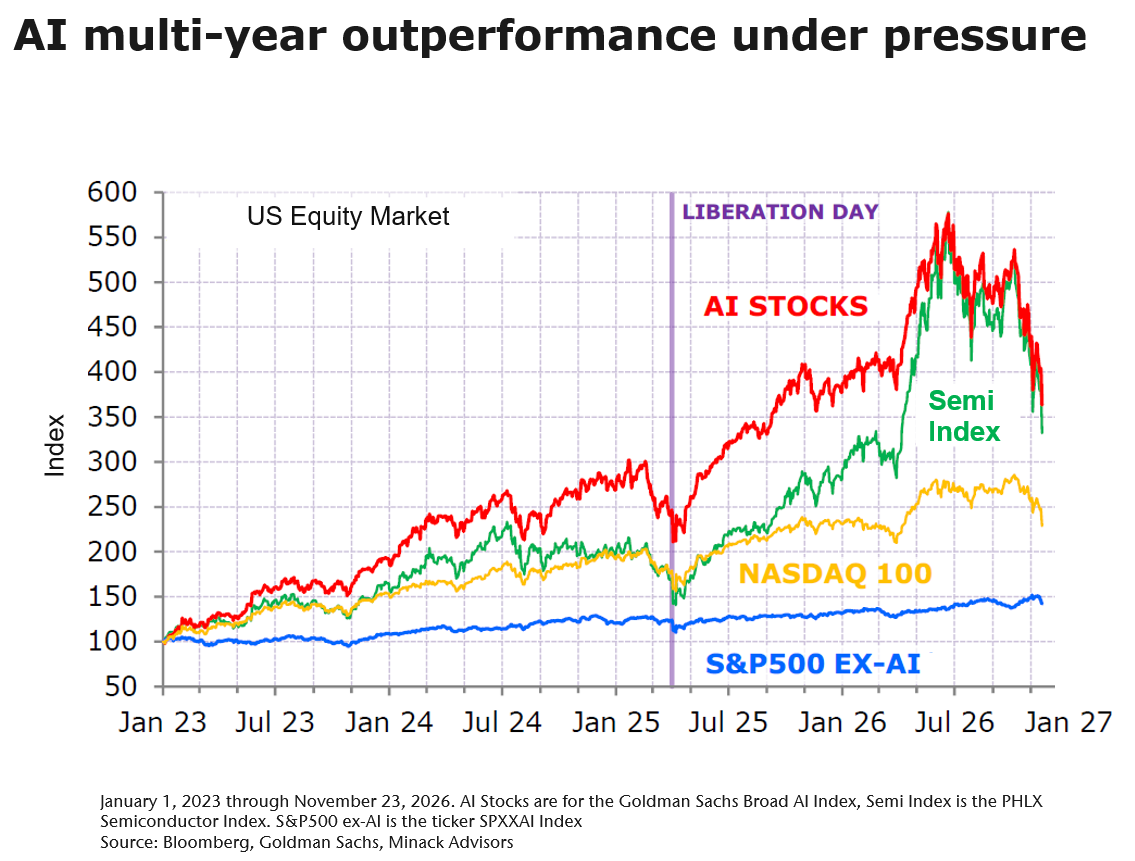
The magnitude of the sell-off stands in contrast to the strength of underlying business fundamentals. Returns on data centre investment have been exceptionally strong, while technology sector earnings are forecast to grow 41% in 2027, compared with 20% for the broader S&P 500. The longer-term question is whether AI adoption can progress fast enough to sustain this extraordinary investment cycle. For now, we view much of the reversal as a healthy reset in investor positioning rather than a meaningful deterioration in fundamentals.
Strong growth, higher interest rates
The investment boom supporting technology earnings is another important source of strength for the broader economy. Despite higher interest rates, the US economy continues to exceed expectations, with third-quarter growth revised upward this week to an annualized rate of 4.3%. Healthy employment and strong business investment give us confidence that the economic expansion can continue into 2027. The challenge is that strong demand is also making it more difficult to bring inflation under control, increasing the likelihood that interest rates remain elevated.
This environment is creating opportunities and challenges across different industries. Growing investment in electricity, energy infrastructure and industrial equipment is supporting demand well beyond the technology sector, while higher borrowing costs continue to weigh on areas such as housing. Even some of the largest technology companies are becoming more sensitive to interest rates as they increasingly turn to debt to finance AI investment. For equity markets, the tension is that strong economic growth continues to support corporate earnings, but higher bond yields may limit what investors are willing to pay for those earnings.
A better starting point for 2027
The recent market correction may ultimately be a healthy development. Lower equity valuations are creating opportunities in businesses whose earnings prospects have changed little. At the same time, higher borrowing costs could help economic growth and AI spending settle at a more sustainable pace, reducing the need for more aggressive rate increases later.
We remain modestly overweight equities and positive on AI as a long-term investment theme. Interestingly, some of the opportunities we see are in established businesses whose vulnerability to AI disruption may have been overstated. Companies with strong customer relationships, proprietary data and established competitive advantages may ultimately strengthen their businesses by adopting AI.
The investment case for traditional bonds has also improved. Higher yields offer a more attractive source of income and the potential for capital appreciation should economic growth slow. Encouragingly, government bonds rallied during the recent equity sell-off, demonstrating their potential to provide diversification even when inflation remains elevated. While persistent inflation continues to warrant caution, we remain underweight duration in client portfolios, but are selectively adding exposure as the outlook for traditional fixed income improves.