November 13, 2026
Key takeaways
- Nvidia's unexpected leadership change unsettled its shares, but gains among competitors suggest the broader AI opportunity remains intact.
- Corporate earnings remain robust, but smaller earnings surprises suggest expectations are increasingly aligned with fundamentals.
- Emerging market earnings growth is expanding beyond the largest technology companies, creating opportunities for active management and more meaningful diversification.
Nvidia's shares fell sharply on Thursday after co-founder and Chief Executive Officer Jensen Huang resigned amid controversy raising corporate governance and national-security concerns. Other artificial intelligence (AI)-linked stocks also declined, but rivals AMD and Broadcom advanced, while the broader United States (US) equity market finished only modestly lower. The contrast illustrates a broader lesson beyond this week's headlines: AI demand can remain healthy even as the companies competing to benefit from it face very different outcomes.
Nvidia's test is about execution
Huang was central to Nvidia's product strategy and its relationships with customers, suppliers and policymakers. Chief Financial Officer Colette Kress has become interim CEO, and Nvidia expects its product plans to continue uninterrupted. However, the sudden departure raises questions about whether those plans, partnerships and the broader AI supply chain can be managed as effectively.
Those risks are not inevitable, nor do they mean companies will stop investing in AI. But they could change which suppliers benefit and how much profit each ultimately earns. Nvidia's challenge is a reminder that a promising industry does not guarantee equally promising returns for every company within it.
Earnings are robust, but expectations are catching up
The same distinction is increasingly visible across corporate earnings. Third-quarter S&P 500 profits are on track to grow more than 30% from a year earlier, with all eleven sectors reporting positive growth. Yet although 84% of companies exceeded forecasts, earnings surprises were smaller than usual. Expectations have risen alongside profits, raising the bar for companies to impress investors simply by reporting growth.
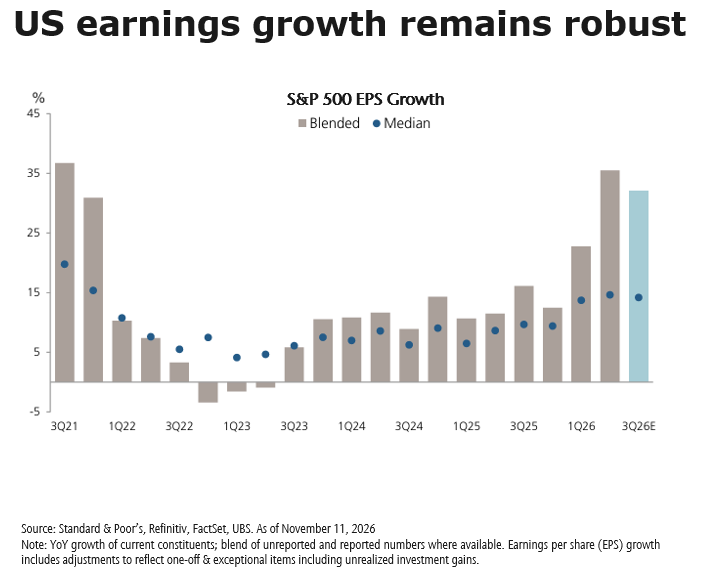
Three themes stand out from this earnings season. First, demand for AI infrastructure must translate into sustainable profits and cash flow. Second, consumers continue to spend but are more value-conscious, making it harder for companies to raise prices. Third, investors increasingly value businesses with dependable demand stretching several years ahead, provided they can deliver profitably. The lesson applies directly to Nvidia: future success will depend on execution, not demand alone.
Emerging markets offer more than one route to growth
This focus on which companies capture earnings growth extends beyond the US. Emerging market (EM) earnings are projected to grow 75% in 2026 and another 25% in 2027. Even excluding three of Asia's largest semiconductor companies, Taiwan's TSMC (a manufacturer of advanced processors) and South Korea's SK Hynix and Samsung (two leading memory chip producers), emerging market earnings are expected to grow 32% in 2026 and 17% in 2027.
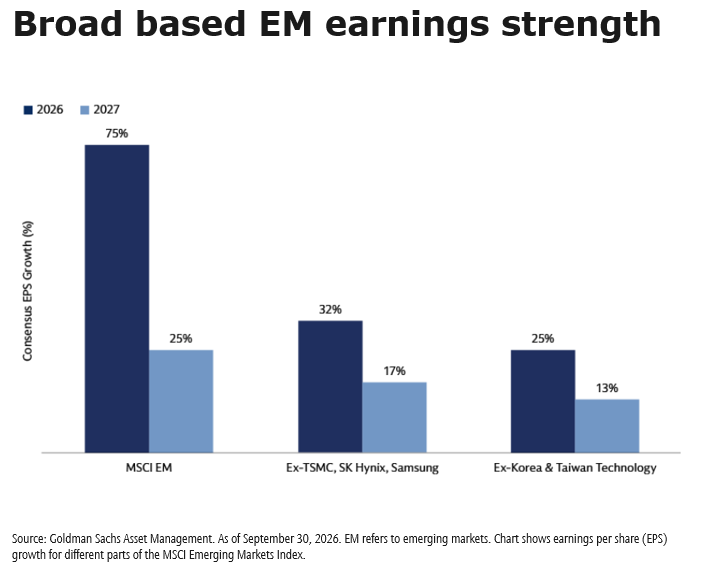
Some opportunities remain tied to the AI supply chain, including chip materials, testing and packaging. Others reflect commodity demand and consumer spending. That broader mix matters because it offers investors access to different sources of profits rather than simply greater exposure to the same technology theme.
Why selection matters for portfolios
At points this year, the difference in returns between the 50 best- and worst-performing stocks over twelve months exceeded 400 percentage points in emerging markets and 200 in developed markets. Those differences create opportunities for careful stock selection, but also make mistakes more costly and do not guarantee active manager outperformance.
For portfolios, the objective is not to abandon AI or simply add more countries. Rather, it is to retain selective exposure to companies benefiting from AI while balancing it with businesses driven by consumer spending, industrial activity and commodities. Genuine diversification depends on what drives earnings, not just where a company is listed.