The United States (US) midterm elections delivered a much stronger Democratic victory than expected, giving the party control of both houses of Congress. After an initial bout of volatility, stocks rallied on Wednesday as political uncertainty eased and hopes of reduced tensions with Iran pushed oil prices and bond yields lower. This offered potential relief from inflation and borrowing costs, benefiting consumers and interest-rate-sensitive businesses. However, the optimism was short-lived. Stocks fell sharply on Thursday, led by artificial intelligence (AI)-related companies, raising questions about what was really driving the sell-off.
Data centres were on the ballot
The election revealed growing resistance to the rapid expansion of AI, extending well beyond party lines. Voters are concerned about the enormous local infrastructure requirements of data centres. There is also broader unease about how quickly AI is advancing and its potential implications for jobs and society. Voters overwhelmingly supported local measures restricting data centre development, while candidates favouring tighter oversight won several important state races.
This could slow the AI buildout and increase costs as developers face tighter restrictions and greater responsibility for infrastructure spending. However, much of the capacity expected in 2027 is already under construction, limiting the immediate impact. The bigger risk is to future projects, which may face delays, higher costs or relocation rather than outright cancellation. The election results added pressure to AI infrastructure and semiconductor stocks, extending a correction that began well before voters went to the polls.
Remember, remember the fifth of November
Equity markets plunged on November 5, a date traditionally marked by fireworks in Britain (commemorating the failed 1605 plot to blow up Parliament). This year, the fireworks were on Wall Street. The magnitude of the sell-off is difficult to explain through fundamentals alone. According to Citadel Securities, earnings estimates for semiconductor companies have increased 30% since June, while their valuations have fallen 35%. Taken together, investors are paying considerably less for profits that are still expected to grow strongly.
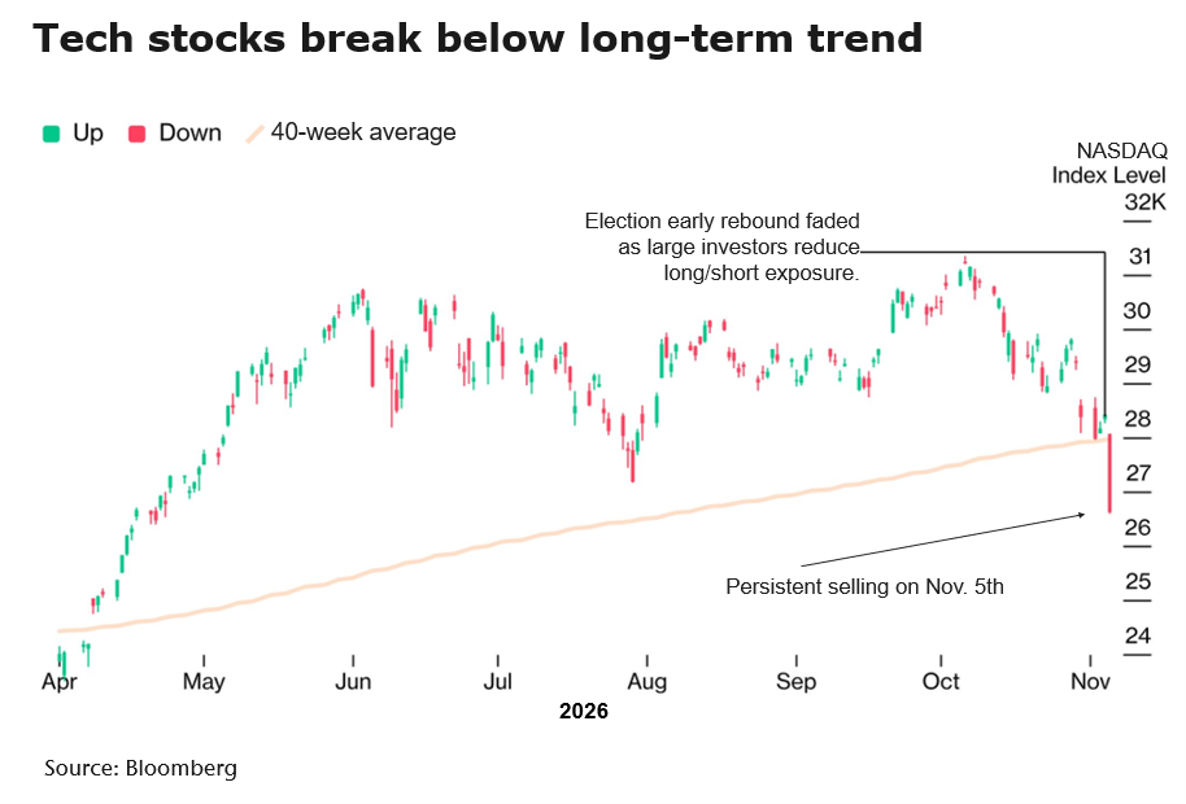
Investor positioning appears to be amplifying the selling pressure. J.P. Morgan reports that hedge funds have reduced their overall market exposure by roughly 8% as top themes like AI have been underperforming. While an 8% reduction in exposure may not sound like much, it is the largest decline in a decade. When leveraged investors reduce risk, they often sell their biggest winners, putting additional pressure on stocks. This can trigger further selling regardless of fundamentals and helps explain why the weakness spread beyond AI into the broader market.
The business cycle matters more than the election
Political events can unsettle markets, but their influence on longer-term returns is usually limited. Corporate profits, interest rates and the pace of business investment will ultimately have a greater influence on markets than this week's political headlines.
The underlying backdrop remains constructive. As of this writing, over 80% of S&P 500 companies that have reported third-quarter results have exceeded earnings expectations, well above the historical average. The global economy continues to expand, supported by business investment and consumer spending. While this week's volatility has been unsettling, sharp market reactions around major events do not necessarily signal a deterioration in economic fundamentals. As of Friday morning, markets are rebounding again, paring back declines as fundamental investors step in to buy after yesterday’s large decline.
The bottom line
The election has increased uncertainty around AI investment, but it has not fundamentally changed the long-term opportunity. We expect greater volatility as markets distinguish between companies spending heavily on AI and those positioned to earn attractive returns. This reinforces the importance of diversification. Bonds have recently helped offset equity weakness, while Canadian and European equities have outperformed the US when AI stocks come under pressure. The goal is to participate in AI's growth without relying on it as the sole source of returns.