October 23, 2026

Key takeaways
- Investors are becoming more concerned about growth, not just inflation. Government bonds rose despite higher oil prices and falling technology stocks.
- AI spending supports US growth, but rising financing pressures could make that source of growth more vulnerable.
- Higher yields offer opportunities to add bonds for income and potential protection if growth weakens.
The week's most revealing move was in bonds. Attacks in Saudi Arabia pushed oil above US$110 a barrel, while doubts about returns on artificial intelligence (AI) investments weighed on technology stocks. Yet government bond prices rose as investors sought safety. Earlier this year, inflation worries often pushed stocks and bonds lower together. What was different this week?
The flip side of the AI boom
AI spending has become an important source of United States (US) growth, but financing that expansion is becoming a greater concern. Major technology companies are investing hundreds of billions of dollars in data centres and computing capacity, absorbing an increasing share of the cash they generate. Meta illustrates the challenge. Despite generating more cash from operations, its quarterly free cash flow fell from US$10.6 billion a year ago to negative US$2.1 billion as investment spending accelerated. Meta remains financially strong, but companies with less financial flexibility may face a tougher choice between borrowing at higher costs and scaling back their AI investment plans. If financing constraints become more widespread, a major source of US growth could weaken, even if demand for AI remains strong. This possibility helps explain why investors sought safety in government bonds.
Oil: the pressure is changing, not disappearing
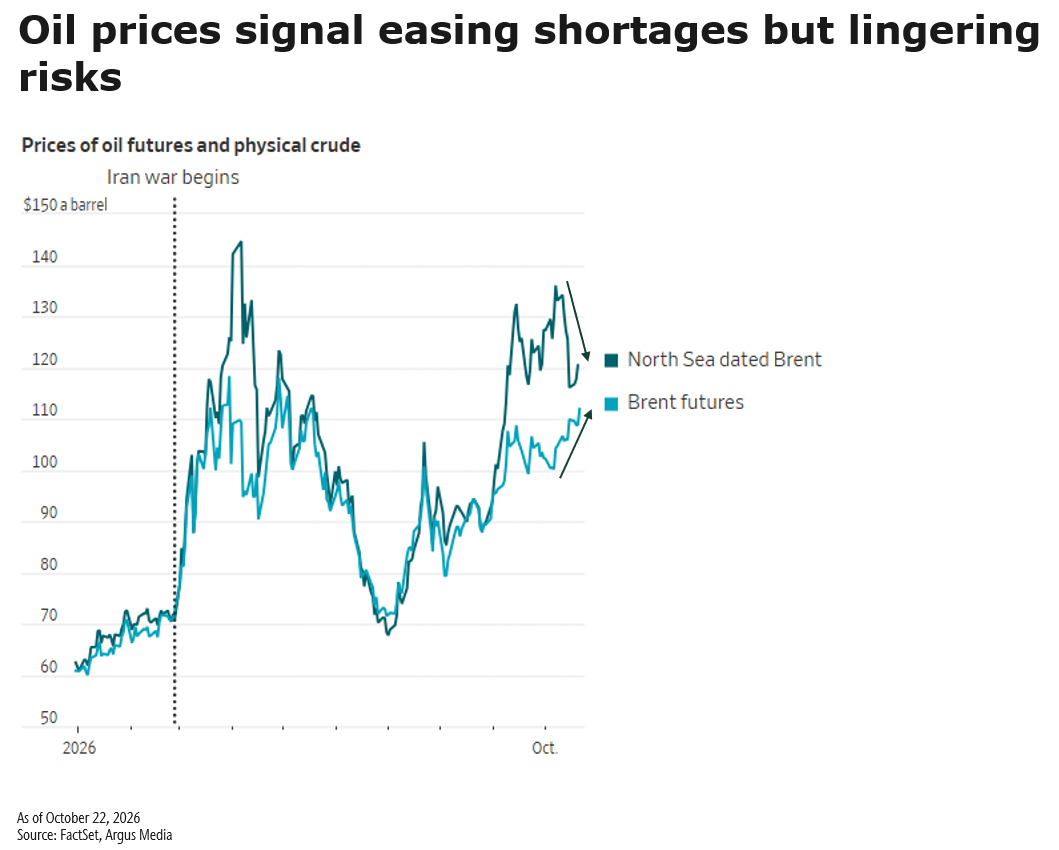
When the Iran war began, oil for immediate delivery became much more expensive than oil bought for future delivery. Buyers faced severe shortages but expected them to ease. As Middle Eastern exports recovered, that price gap narrowed. Meanwhile, prices for future delivery rose amid concerns about renewed fighting after the US midterm elections. The chart shows that immediate shortages have eased, but fears about future supply have not disappeared.
Higher oil prices reach consumers through more than gasoline. Diesel fuels trucks and ships, so sustained high prices can increase transportation costs across the economy. US inflation accelerated to 3.7% in September, with underlying inflation also rising. The Federal Reserve must weigh stubborn inflation against weaker growth. Markets now see little chance of an interest-rate increase next week.
Canada faces a different choice. Headline inflation reached 3.1%, partly because of energy, but the Bank of Canada's preferred underlying measures averaged 1.9%. With hiring and housing weak, there is a case for patience despite market expectations of a rate increase.
What this means for bonds
Higher oil costs also squeeze household budgets, while uncertainty about AI spending raises questions about future business investment. Investors are weighing both effects: persistent inflation can push bond yields higher and prices lower, but slower growth can bring buyers back into high-quality government bonds. This week, growth concerns won out. That does not guarantee bonds will rise whenever stocks fall, but it demonstrates the protection they can offer, now alongside considerably more income.
How we are positioning
Within core fixed income, we remain cautious about holding too many longer-term bonds because they can lose value if yields rise again. But the recent increase in yields may have gone too far, too quickly. We are selectively adding some longer-term exposure that could benefit if yields fall, modestly increasing holdings of high-quality corporate bonds and looking for opportunities in provincial bonds. Government bonds offer potential protection from weaker growth, while carefully selected corporate and provincial bonds can add income.
The bottom line
This week's market reaction highlights an important shift. Investors are no longer focused solely on inflation; they are also considering what happens if a major source of US economic growth begins to slow. With yields now considerably higher, high-quality bonds may offer meaningful income alongside the potential to protect portfolios if growth disappoints. This supports selectively rebuilding exposure to traditional bonds, while remaining mindful that persistent inflation could keep interest rates elevated.