August 07, 2026

Key takeaways
- Markets are reaching new highs because resilient spending and healthy profits are driving earnings growth across a broader range of companies.
- AI remains a powerful investment theme, but the market is becoming more discerning — distinguishing between companies spending heavily on AI and those positioned to earn attractive returns from it.
- The market backdrop remains positive, but the bar is rising; elevated valuations, higher interest rates and greater uncertainty reinforce the importance of quality and diversification.
Equity markets are back at record highs even though the backdrop remains uncomfortable. AI stocks pulled back sharply in July, geopolitical risk remains elevated, inflation is still high, and interest rates could become a greater headwind if financial conditions tighten. Even so, markets have continued to move higher.
The reason is that these risks have not yet meaningfully weakened the spending and investment supporting corporate earnings. Consumer spending remains healthy, businesses continue to invest well beyond artificial intelligence (AI), government spending remains supportive, and credit is still available. Together, these forces are supporting revenue growth, while healthy margins are allowing profits to grow even faster.
Importantly, earnings strength is broadening. Every sector in the S&P 500 is exceeding earnings growth expectations, suggesting that profit growth is extending well beyond the largest technology companies. In aggregate, companies are growing earnings by 47% year-over-year — an extraordinary rate, and more than twice what was expected before reporting season began.
That helps explain why markets can continue to advance even when some previous leaders lose momentum. Strong earnings do not eliminate the risks, but they give markets a greater ability to absorb them. The key question is not whether risks exist, but whether they become strong enough to break the link between resilient spending, corporate earnings and market returns.
AI earnings strengthen the demand case — not yet the return case
Recent earnings provide stronger evidence that AI demand and monetization are real. What they have not yet proven is whether the returns will ultimately justify the extraordinary amount of capital being invested.
The major cloud platforms recently reported exceptionally strong growth, demand continues to exceed available capacity in some areas, and commercial adoption is becoming more visible. Microsoft provides a useful example. Azure and other cloud services revenue grew 43% year-over-year last quarter, demand continued to exceed available capacity, and Microsoft 365 Copilot surpassed 30 million paid seats.
The change is also showing up in market leadership. After semiconductor stocks weakened through much of July, hyperscalers rebounded sharply following strong earnings. The rotation does not suggest that demand for chips or AI infrastructure has disappeared; in fact, capacity constraints remain significant. Instead, it suggests investors are giving more credit to companies beginning to demonstrate how AI investment can translate into revenue and profits.
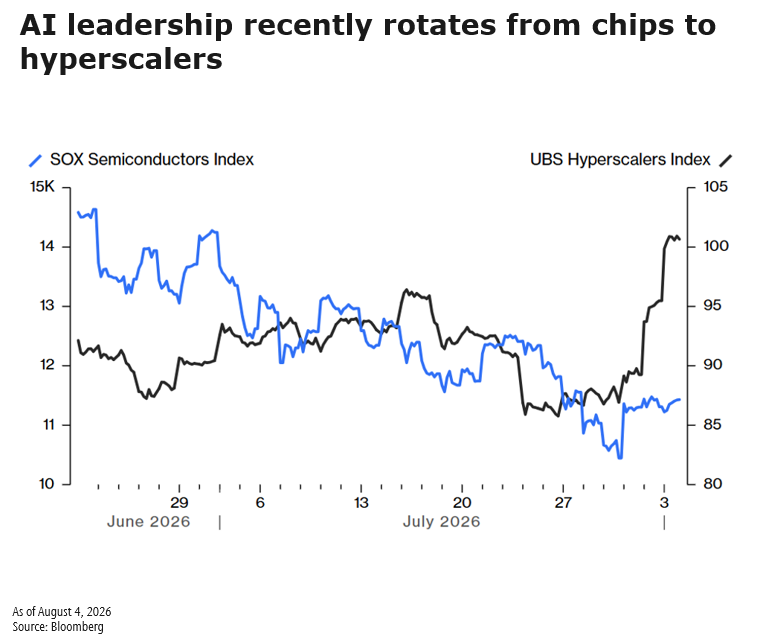
However, meeting that demand remains extraordinarily expensive. Capital spending continues to rise rapidly, putting pressure on cash flow and raising the bar for companies to eventually demonstrate attractive returns. Competition and cheaper models could also change where those profits ultimately accrue. The latest earnings therefore reinforce both sides of the AI story: the investment cycle remains powerful, but future returns are likely to depend increasingly on which companies can turn that spending into durable revenue, profits and cash flow.
A positive backdrop, but a higher hurdle
The market backdrop remains positive, but expectations are also high. After several years of strong returns, valuations in many areas already reflect healthy growth and continued earnings strength. Companies do not necessarily need to disappoint for markets to come under pressure; when expectations are elevated, even great news becoming merely good news can be enough.
This is why the broadening of earnings and market leadership is important. More companies and sectors contributing to profit growth reduces the market’s dependence on a relatively small group of winners and creates more opportunities across regions and industries. With expectations already high, that broader foundation reinforces the importance of diversification, earnings durability and valuation discipline.