July 31, 2026

Key takeaways
- July’s reversal in semiconductor and AI infrastructure stocks reflected crowded positioning and elevated expectations — not a collapse in AI demand.
- Strong earnings across sectors allowed market leadership to broaden beyond mega-cap technology, creating a healthier foundation for US equities.
- The AI cycle is evolving and should reward companies that can translate investment into sustainable revenue, cash flow and productivity gains. Higher yields should reinforce the importance of reasonable valuations and diversification.
July delivered the sharpest challenge yet to the market leadership that had dominated the first half. Semiconductor and other Artificial Intelligence (AI)-linked stocks — many of the strongest performers in the first half of the year — fell heavily, while market breadth improved as gains spread across a wider range of sectors and companies. Rather than signalling a broad deterioration in equities, the shift reflected a rotation away from a narrow group of expensive winners and toward businesses supported by improving earnings and more attractive valuations.
The AI trade met a higher bar
The decline in AI infrastructure leaders looks more like an abrupt reversal of an overcrowded trade than the end of the AI investment cycle. Spending on chips, data centres, networking and power remains at unprecedented levels. What changed was investors became less willing to assume that every company benefiting from the buildout would continue to deliver exceptional growth and profitability.
Some of the unease came from the growing web of investments and purchases among chipmakers, cloud companies and AI start-ups. These relationships make it harder to judge how much demand is coming from paying customers rather than money circulating within the industry.
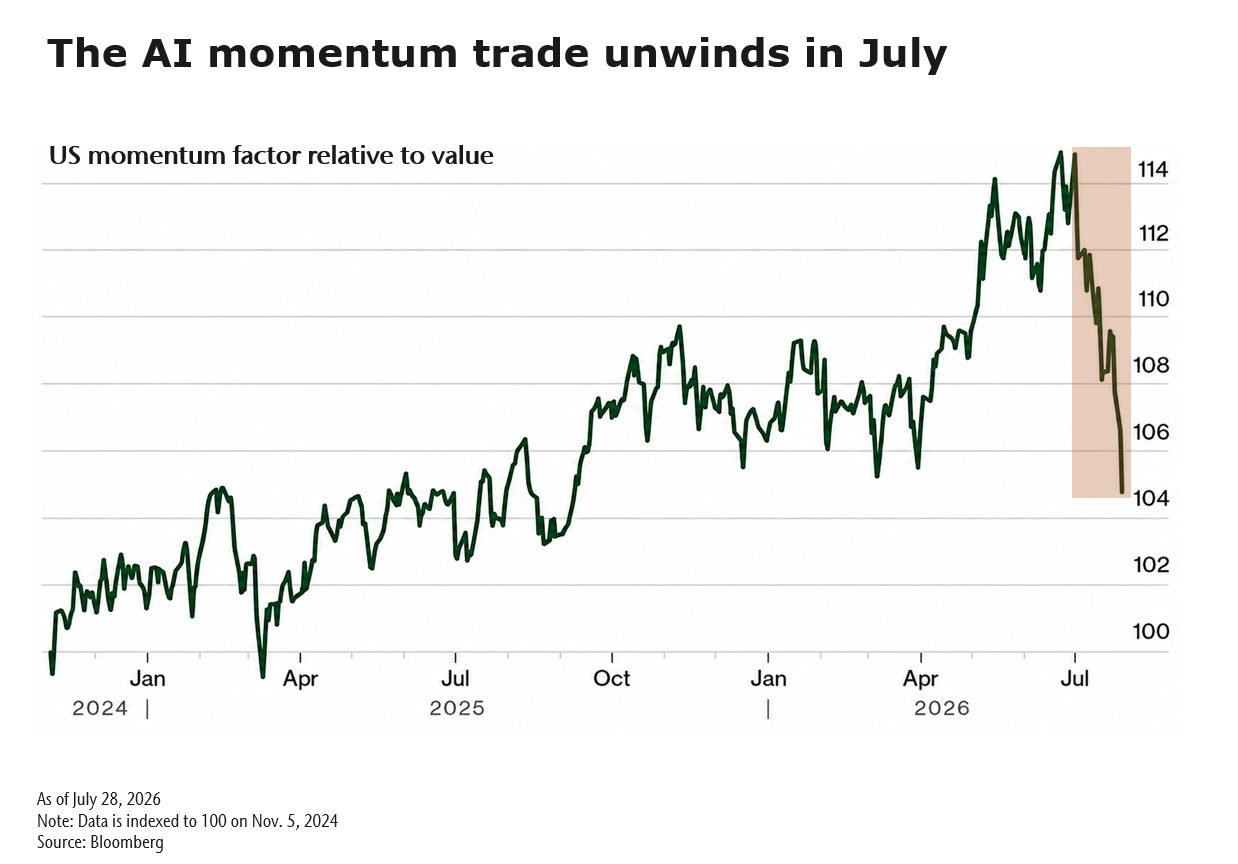
The shift in sentiment quickly became a clear change in market leadership. The Russell 1000, an index representing roughly 1,000 of the largest publicly traded US companies, demonstrates the scale of the move. Its 25 best-performing stocks in the first half, largely semiconductor and AI infrastructure companies, fell by an average of more than 36% in July. At the same time, the index’s 25 weakest first-half performers gained an average of 14%. Stocks that had been rising fastest also trailed lower-valued companies by roughly 10% during July, highlighting how decisively investors moved away from the previous winners.
The following chart captures the speed of that reversal. It also illustrates an important lesson: trends can persist for a long time, but they can unwind quickly when expectations become too high and confidence in the prevailing narrative begins to fade.
Earnings broadened beyond mega-cap technology
The rotation was not simply a move into traditionally steadier companies. Investors increasingly found attractive earnings growth across financials, industrials, materials, consumer businesses and smaller companies. Corporate results supported that shift: by late July, 86% of the S&P 500 companies that had reported had exceeded profit forecasts, with positive surprises spread across most sectors.
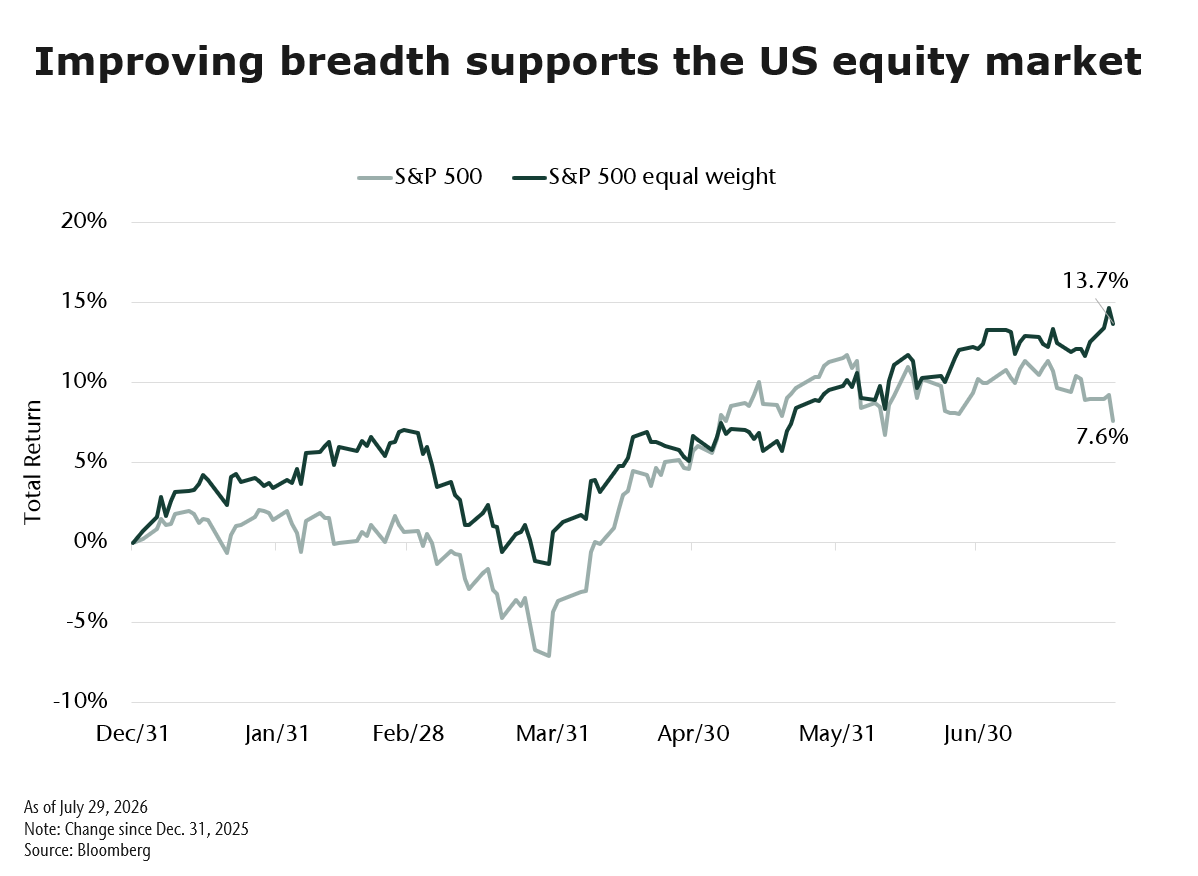
This wider participation helped the market remain resilient even as several of its largest technology companies weakened. The contrast is visible when comparing the market-cap-weighted S&P 500, where the largest companies have the greatest influence, with its equal-weighted counterpart. The latter’s outperformance year to date shows that returns are increasingly being supported by a wider range of companies. Broader earnings strength has created a healthier and more balanced foundation for US equities.
Higher yields rewarded earnings discipline
Higher bond yields reinforced this shift. When yields rise, profits expected many years from now become less valuable today. That creates greater pressure on expensive companies whose valuations depend heavily on distant growth, while favouring businesses already producing dependable earnings and cash flow.
The Federal Reserve kept interest rates unchanged in July, but disagreement among policymakers showed that inflation risks have not disappeared. Borrowing costs may therefore remain high for longer than investors had hoped. Higher yields were not the catalyst for the technology reversal, but they made investors less forgiving of elevated valuations and uncertain future returns.
What this means looking forward
The AI cycle continues to evolve. Demand should remain relatively strong in genuine bottlenecks such as memory, networking, power and specialized data-centre equipment. At the same time, cheaper models and more efficient computing could lower prices while encouraging wider adoption.
The next phase may increasingly reward companies that can use AI to generate revenue, improve productivity or expand margins—not merely those associated with building the infrastructure. Canadian banks, which have been key contributors to Canadian equity market returns this year, provide a good example. They hold vast amounts of data and can use AI to streamline labour-intensive analysis and administrative processes, which could help lower costs and improve profitability over time. Their competitive advantages also rest primarily on scale, trusted brands and regulation, making them relatively well insulated from direct AI disruption.
More broadly, market leadership is likely to become wider and more selective. Opportunities remain in AI, but future returns should depend more on company-specific advantages and profitability.
For investors, July’s message may be viewed as constructive: a market supported by more sectors and more sources of earnings is healthier than one dependent on a handful of stocks. In this environment, diversification, valuation discipline and careful company selection should matter more.