October 09, 2026

Key takeaways
- Equities remained surprisingly resilient despite higher oil prices and rising bond yields, as strong corporate earnings continued to offset pressure from inflation and higher borrowing costs.
- Higher oil prices complicate the inflation outlook and give the Fed less room to ease policy, increasing the risk that interest rates and bond yields remain elevated.
- For Canadian investors, the impact is mixed: stronger energy prices can support domestic equities, while higher yields increase pressure on rate-sensitive investments and raise the bar for future equity gains.
Equity markets showed notable resilience this week despite a backdrop that would normally be more challenging for stocks. Large technology companies helped lift the Nasdaq 100 to a record early in the week and brought the S&P 500 close to one, even as oil prices and bond yields remained elevated. By Thursday, Brent crude had risen above US$102 a barrel as Middle East tensions intensified, while government bond yields remained near multi-decade highs.
Both developments raise inflation concerns and increase the cost of capital, which would typically place greater pressure on equity markets. So far, however, strong corporate earnings have been enough to offset much of that pressure. The question is how long that can continue as the hurdle from higher rates rises.
Higher oil makes elevated yields more difficult
Higher oil prices matter because they can feed directly into gasoline, transportation and production costs, making inflation more persistent. That becomes more important when bond yields are already high.
Investors have spent much of this year balancing strong corporate earnings against a higher cost of capital. If oil keeps inflation elevated, central banks have less flexibility to lower interest rates, increasing the likelihood that borrowing costs will remain high for longer.
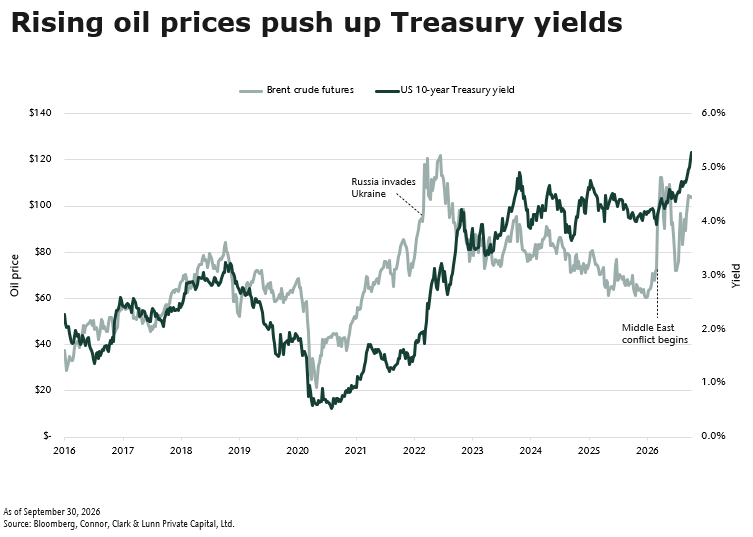
That combination can be particularly difficult for equities. Higher government-bond yields give investors a more attractive alternative to stocks, while also increasing companies’ financing costs and reducing the value investors place on earnings expected further into the future.
High yields are not necessarily bad for equities when they reflect strong growth and earnings. They become more difficult when inflation is what keeps them high.
The Fed has less room to provide relief
Minutes from the Federal Reserve’s (Fed’s) September meeting showed broad support for raising interest rates and reinforced policymakers’ focus on inflation. Another increase is not necessarily imminent. Officials have indicated they have flexibility over the timing of further moves and can continue assessing incoming data.
The more important issue for markets is that persistent inflation reduces the Fed’s ability to provide relief through lower rates. That can affect markets before any formal policy change occurs. If investors expect interest rates to remain elevated, bond yields and borrowing costs can rise in anticipation.
AI is carrying more of the market
Against that backdrop, Artificial Intelligence (AI)-related companies have become increasingly important to the market’s resilience. Exceptional earnings growth and expectations for continued investment in data centres, semiconductors, power infrastructure and related technologies have supported some of the largest companies in global equity markets. However, that strength also creates a higher bar.
At current valuations and bond yields, merely good earnings may no longer be enough. Investors are expecting AI-related companies to deliver unusually strong growth while continuing to justify enormous capital spending. That means a relatively small group of companies is carrying a disproportionate share of the burden of supporting market returns.
If those earnings continue to exceed expectations, they can help offset the drag from higher rates. If growth disappoints, elevated valuations leave less room for error.
A mixed picture for Canadian investors
For Canada, higher oil prices create both benefits and risks. Energy represents a larger share of the Canadian equity market than it does in the United States (US), so stronger commodity prices can lift producers’ profits, support domestic equities and provide some support to the Canadian dollar.
At the same time, higher energy costs can reinforce inflation pressures, while rising US Treasury yields often put upward pressure on Canadian government and corporate bond yields. That can weigh on rate-sensitive areas such as real estate, utilities and longer-duration bonds.
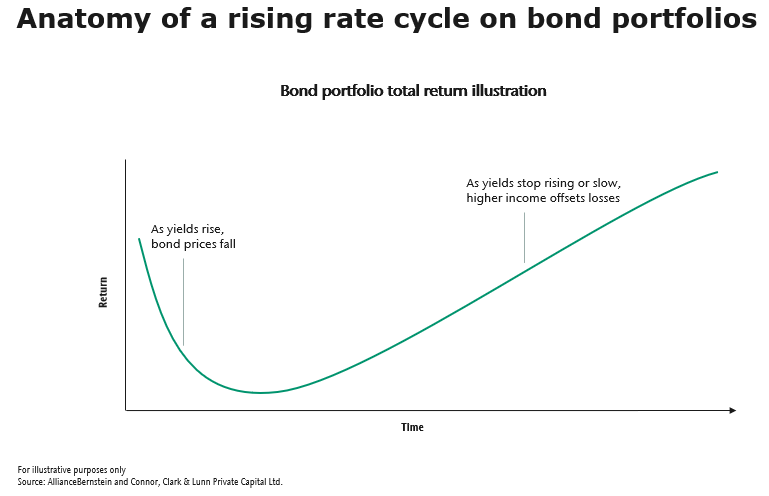
There is also a longer-term benefit for fixed-income investors. Falling bond prices result in higher yields, improving prospective income as portfolios reinvest at those higher rates.
Earnings are doing more of the work
The central market story remains one of unusually strong earnings overcoming an increasingly demanding interest-rate backdrop. Corporate profits — particularly among AI-related companies, but also in areas such as energy and Canadian banks — have been strong enough to support equity markets despite higher oil prices, persistent inflation concerns and elevated bond yields. However, the margin for disappointment is narrowing.
For Canadian investors, the environment continues to favour diversification: energy can provide some protection from rising commodity prices, fixed income is offering more attractive yields, and companies capable of generating durable earnings and cash flow may be better positioned as the market becomes more selective.