September 25, 2026

Key takeaways
- Strong US business activity and higher oil prices are keeping inflation risks elevated and pushing bond yields higher.
- Earnings forecasts are rising, but higher bond yields are putting pressure on what investors will pay for those expected profits.
- Higher yields reinforce the importance of dependable earnings, cash flow, strong balance sheets and reasonable valuations.
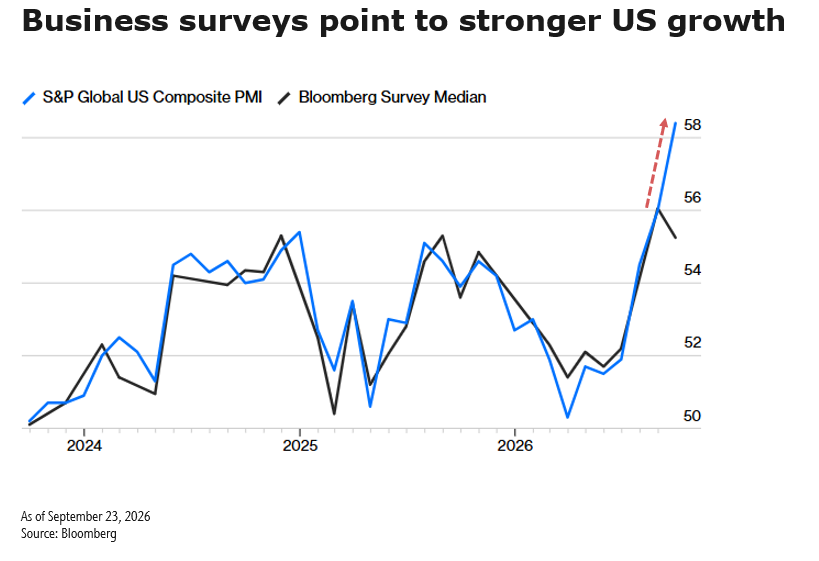
United States (US) bond yields moved sharply higher this week, with the five-year Treasury yield rising above 5% for the first time since 2007. Stronger-than-expected business activity helped drive the move.
Recent business surveys point to the fastest expansion in US business activity in more than five years. Companies are adding staff at a faster pace and reporting rising costs. The concern is not strong growth alone, but that customer demand may rise faster than businesses can keep up. That can cause prices to rise more quickly, making inflation harder to bring down and keeping interest rates elevated. Higher oil prices add to the pressure, particularly if businesses pass those costs on to customers.
Earnings forecasts and valuations diverge
Earnings forecasts are moving higher, yet investors are paying less for each dollar of expected profit. Higher bond yields help explain the divergence: they offer a more attractive alternative to stocks, putting pressure on valuations even as the earnings outlook improves.
Earnings results are helping equity markets withstand the pressure from higher bond yields. The adjusted earnings of S&P 500 companies grew 32% from a year earlier in the second quarter. Strong earnings were not limited to artificial intelligence (AI)-related businesses, with many consumer and industrial companies also reporting healthy profit growth. Analysts are raising profit forecasts across regions, reflecting expectations that companies will keep more of each dollar of sales as profit.
The contrast is particularly striking among AI suppliers such as Samsung, SK Hynix and Micron Technology. Earnings forecasts for these three major memory-chip producers have risen 450% since the start of the year, yet the group trades at less than five times expected earnings. Although this is an extreme example, the pattern of rising profit forecasts and falling valuations extends across several major markets.
What this means for share prices
Falling valuations do not necessarily mean falling stock prices. Stocks can still rise if companies are expected to earn more money and that improvement is large enough to offset lower valuations.
The AI boom does not need to end for stock returns to moderate. Exceptionally strong earnings growth remains a key support, but lower valuations can absorb part of that benefit.
Cash flow and the price paid matter more
This is not simply a case for favouring value stocks over growth stocks. What matters most is owning companies with dependable earnings, strong cash flow and manageable debt, at prices those strengths can justify. Growth companies can meet those tests too. A stock is not necessarily a good investment just because it is inexpensive relative to its earnings.
Companies that generate enough cash to fund their investment have less need to borrow at higher rates. Strong balance sheets also give businesses more flexibility to pursue opportunities, rather than directing an increasing share of cash toward interest payments.
If yields remain elevated, returns are likely to depend more on profit growth and income than on investors paying more for each dollar of earnings. Falling valuations can weigh on current returns, but lower starting valuations can improve the potential for future gains if earnings remain strong. The opportunity is to participate in exceptional earnings growth while remaining disciplined about the price paid.