September 04, 2026

Key takeaways
- Bond yields are rising across major markets, suggesting the pressure on long-term borrowing costs extends well beyond what the Fed does next.
- Government spending and AI investment are supporting growth and earnings while adding to the pressures pushing bond yields higher.
- Persistent pressure on bond yields does not call for a major portfolio shift. We build portfolios across stocks, bonds and alternatives so success does not depend on any one outcome for rates, growth or AI.
Two of the defining themes of this cycle — fiscal expansion and the artificial intelligence (AI) investment boom — are increasingly colliding in the bond market. This week’s renewed rise in long-term yields across major markets provides further evidence that the pressure is becoming broader than expectations for the next Federal Reserve (Fed) decision.
Government debt levels are becoming harder to ignore. Large deficits require ongoing borrowing, while there is little sign of near-term fiscal restraint. As a result, investors are increasingly demanding higher returns to provide that financing. At the same time, the enormous AI buildout is moving beyond cash funding toward greater use of debt and other forms of financing, putting governments and AI-related borrowers in growing competition for the same capital.
The story cuts both ways, however. The government spending and corporate investment contributing to higher yields are also helping support economic growth and company earnings. In other words, the forces pushing borrowing costs higher are also helping markets absorb them, at least for now.
Strong earnings keep equity markets resilient
Strong earnings are the main reason equities have absorbed higher bond yields so well. As the chart below shows, S&P 500 earnings growth is running at one of its strongest rates in decades, reaching levels last seen during the recoveries from the Global Financial Crisis and the pandemic. What makes today’s acceleration unusual is that it has not followed a comparable economic downturn.
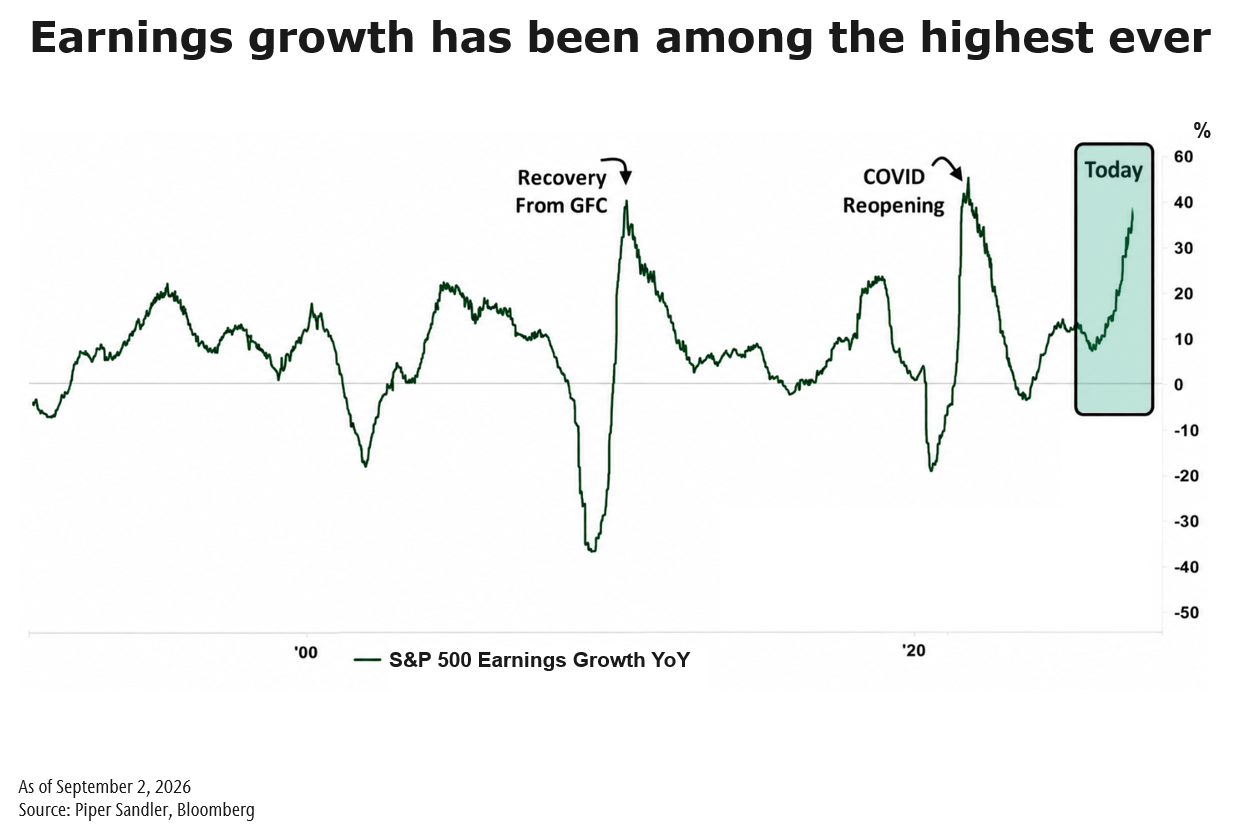
The strength also extends beyond the largest companies. Profit expectations for 2026 and 2027 continue to be revised higher, rather than following the usual pattern of being lowered over time. In fact, roughly 80% of United States (US) stocks have seen earnings expectations improve.
Higher bond yields can weigh on stock prices by giving investors more attractive alternatives and making them less willing to pay a premium for future earnings. That puts more of the burden on companies to deliver actual profit growth. So far, exceptionally strong earnings have been enough to clear that higher hurdle.
Portfolio positioned for uncertainty
Persistent upward pressure on bond yields is a risk, but it is not a reason for a major portfolio shift. While current government borrowing trends cannot continue indefinitely, it is difficult to know when or how they will adjust. Fiscal restraint, stronger growth or persistent inflation would each have very different implications for markets.
That is why different parts of a portfolio are designed to respond differently. Rising yields can weigh on bond prices initially, but they also increase the income and future return potential of fixed income. Strong earnings continue to support equities, although persistently higher borrowing costs could eventually slow growth and profits. Alternatives provide additional sources of return with different sensitivities to interest rates, economic growth and public-market valuations.
Portfolio construction starts with some humility: we cannot predict with confidence how these megatrends will play out in the near term or how markets will react. We monitor the evidence and adjust positioning as conditions evolve, while building portfolios that do not depend on one outcome for success. That means spreading risk across asset classes, investment styles, global markets, and private investments with different return drivers.