August 28, 2026

Key takeaways
- Strong earnings pushed equity markets to new highs in August, but the gains were uneven.
- Bond yields moved higher as heavy government borrowing and enormous AI-investment needs increased demand for capital.
- AI demand remains exceptionally strong, but the economics are becoming more uncertain.
Month-end moves: While the broad August story remains the same, certain developments post publication added nuance. While the Fed had been expected to remain on hold, Chair Warsh’s Jackson Hole comments on Friday, August 28 made the path less certain, with markets pricing a roughly 65% chance of a September hike and higher odds of at least one hike by December. At the same time, Nvidia’s results and longer-dated revenue guidance helped spark the semiconductor rebound that had been missing for much of August, narrowing software’s lead within technology but not fully reversing the month’s pattern. While these late-month moves bear mentioning, they sit within the same broader frame of “new highs, higher hurdles”.
Equity markets reached new highs in August as another strong earnings season supported the corporate outlook. At the same time, market leadership shifted. Materials were the strongest-performing sector, helped by rising gold prices as concerns about United States (US) debt increased and the US dollar weakened. Technology also performed well, but performance varied widely within the sector. Semiconductor returns were more modest overall, while software stocks rebounded sharply as better-than-expected earnings eased concerns that artificial intelligence (AI) would quickly disrupt their businesses. Together, these were meaningful reversals. Meanwhile, more interest-rate-sensitive sectors (such as utilities and real estate) lagged as bond yields continued to rise.
These moves highlight the two forces shaping markets today. Higher bond yields are increasing the cost of capital, while AI continues to create large differences between companies and industries. Earnings remain strong enough to support markets, but the hurdle for future returns is getting higher.
Higher bond yields are becoming more than a central bank story
Long-term bond yields continued to rise in August even as the Federal Reserve (Fed) remained on hold and expectations for near-term tightening eased. Normally, that would take some pressure off yields. Instead, investors are increasingly focused on the amount of capital that governments and companies need to raise. Large fiscal deficits require heavy government borrowing, while AI, data centres and power infrastructure are driving enormous private-sector demand for capital.
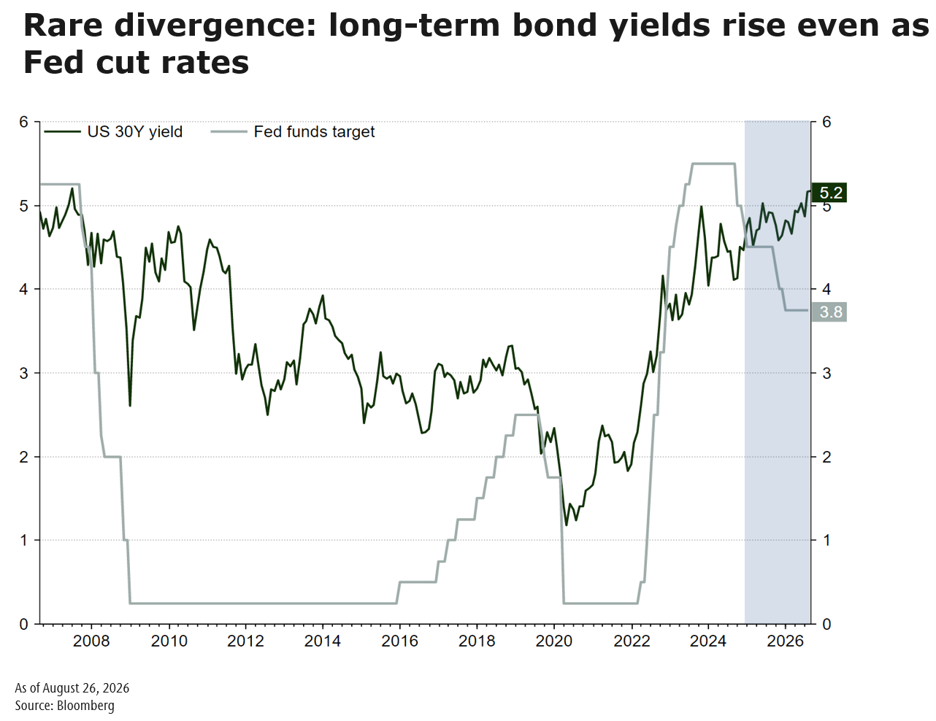
The US Treasury’s decision to increase purchases of longer-dated bonds has added to those concerns. The program is intended to improve market liquidity, but the announcement came after long-term yields reached multi-decade highs despite no obvious signs of market dysfunction. Critics argue that trying to manage the level of yields risks obscuring the message from bond markets without addressing the underlying problem: large deficits and rising borrowing needs.
The broader message is that the Fed is no longer the only force shaping long-term rates. Governments and companies are competing for capital at the same time, which could keep borrowing costs higher even without further central bank tightening. For investors, that means a higher cost of capital and a higher bar for future returns.
AI demand remains strong, but the payoff remains uncertain
AI demand remains exceptionally strong, but the path to profits is under closer scrutiny. Microsoft, Alphabet, Amazon and Meta are expected to invest as much as $750 billion this year, a scale with few historical comparisons when measured against the size of the US economy. Spending this much at this pace only makes sense if AI ultimately generates enormous revenues and cash flows.
The risks are rising. AI usage and revenues continue to grow rapidly, but competition is intensifying and the price of using leading models has fallen sharply as cheaper models and greater efficiency emerge. At the same time, companies are building enormous computing and power capacity, increasingly financed with debt even as borrowing costs rise. If demand does not grow as quickly as capacity, returns on that investment could fall well-short of expectations.
This does not undermine the long-term potential of AI, but it does raise the pressure on companies to show results. Strong demand is increasingly clear, but the payoff remains uncertain. Companies must now generate enough growth to offset falling prices, higher financing costs, and the risk of excess capacity. This helps to explain the large shifts in market leadership within the AI theme.
What we are watching
Into September, three questions are top of mind. Do long-term bond yields remain elevated even if the Fed stays on hold? Can AI revenues grow fast enough to justify rising investment and financing costs? And will escalating Canada-US trade tensions begin to weigh more meaningfully on Canadian investment and growth?
For portfolios, the most immediate risk from higher yields is lower valuations. We have already seen this in parts of the market and expect valuations to remain an important driver of returns. Within equities, this reinforces our focus on quality companies with healthy cash flows and reasonable debt levels. In fixed income, we continue to favour credit and diversified income strategies over core bonds that are more sensitive to interest rates. Hedge strategies can also be particularly valuable in periods like this because their returns have low correlation to public markets.
For now, strong earnings continue to support markets and the economic expansion, while these pressures remain contained. That leaves us comfortable with a balanced position that can participate if markets continue to advance, while reducing our reliance on any single market outcome.