August 14, 2026

Key takeaways
- July’s inflation data support the case for the Fed to remain on hold, while a stronger-than-expected August reading could revive the possibility of a rate hike.
- Hiring surprised to the downside in July, but there was little evidence of a broader deterioration in the labour market.
- Healthy corporate fundamentals and wider global market participation are creating opportunities beyond US technology.
The market received a more balanced message from the United States (US) economy this week. July inflation eased, with headline inflation falling to 3.4% year-over-year and core inflation to approximately 2.5%, alongside a slowdown in producer prices. Lower energy prices and fading temporary pressures helped, but inflation remains above the Federal Reserve’s (Fed) target and price pressures are still relatively broad. More than half of core inflation categories are increasing at a rate above 2%, while housing and other service costs remain persistent.
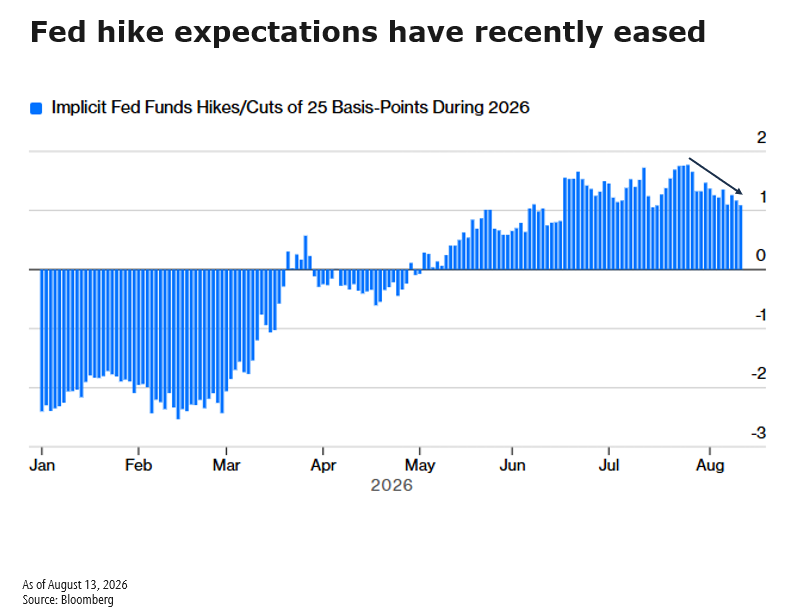
Meanwhile, weaker-than-expected job growth reduced the urgency for another rate hike. Together, the data give the Fed more room to wait. The most likely path is therefore a prolonged pause: another inflation setback could lead to a further hike, while rate cuts would likely require a more meaningful weakening in employment and consumer spending.
Markets have responded favourably to this combination. Inflation and hiring have cooled enough to reduce pressure on the Fed to tighten further, while low layoffs and healthy corporate fundamentals suggest underlying economic activity remains intact.
Corporate growth is outpacing job creation
Another important development is the growing gap between the labour market and corporate America. July’s surprisingly weak job numbers highlighted a clear slowdown in hiring activity, though employers are not yet resorting to widespread job cuts. Recent data on new unemployment claims remain low, suggesting businesses are holding onto existing staff even as they become more cautious about expanding their workforce.
Listed companies are telling a more constructive story. Revenues, earnings and business investment remain healthy, and equity leadership has spread into more economically sensitive areas. One explanation is that companies are becoming more productive—using technology, automation and capital investment to generate more output without needing the same increase in headcount.
This helps explain why weaker job creation has not translated into weaker stock markets. It also introduces an important risk: if softer hiring eventually weighs on household income and spending, the gap between corporate growth and the labour market may become harder to sustain.
The bull market is becoming more global
Equity returns are increasingly extending beyond the US. Across nearly 50 single-country ETFs, the median is up roughly 12% this year, close to the S&P 500’s 14% gain. Notably, 86% are trading above their 50-day moving average and 43 have reached a 52-week high this year. Many of the better-performing countries also have relatively little exposure to technology.
Importantly, different parts of the market are being supported by different economic drivers. Energy, materials and capital goods are benefiting from commodity demand and industrial investment. AI-related spending is also extending beyond the technology sector into data centre construction, power generation, grid infrastructure and other physical assets. Financials have participated as well, supported by solid bank earnings, resilient lending activity, and stronger capital markets revenues. The significance is that this rally has more than one engine: global returns are becoming less dependent on a single US technology theme.
The bottom line
Wider market participation is constructive for diversified portfolios. While AI remains an important long-term theme, we are not reliant on it as the sole source of return.
A recent example of portfolio resilience is our quantitative strategies, which held up well through July’s AI selloff. This highlights the value of a differentiated investment process with return drivers that are less dependent on the prevailing market theme.
The key message this week is that markets continue to find support despite softer hiring and geopolitical uncertainty. Moderating inflation has reduced pressure on interest rates and bond yields, while strong corporate profits and wider global market participation continue to underpin equities.