July 24, 2026

Key takeaways
- Markets are under pressure from renewed inflation risk and higher interest rates. Rising oil prices driven by Middle East tensions are raising the prospect of rates remaining elevated or moving higher, weighing on both stocks and bonds.
- Investors are demanding clearer returns from record AI spending, as hyperscalers face weaker cash flow while chipmakers benefit from the buildout.
- Market volatility may remain elevated as these risks converge. Higher energy prices and less predictable inflation are making the outlook for interest rates, economic growth and corporate earnings harder to assess, just as investors question the returns on heavy AI investment.
Markets faced two reinforcing concerns this week: renewed inflation fears from rising oil prices and mounting questions about whether heavy AI investment will translate into profits. The resurgence of the Middle East conflict pushed Brent crude above $100 a barrel (roughly 40% above its July 1 low), raising the risk that higher fuel and transport costs could cause inflation to accelerate again. United States (US) equities fell as the Magnificent 7 stocks were hit hard, losing $767 billion in market value in one session. Bonds also declined as the 10-year US government bond yield rose to 4.7%, its highest level this year.
The important point is not simply that oil rose or technology sold off. Higher energy prices can squeeze household spending and company profit margins while also reducing the Federal Reserve’s (Fed’s) ability to lower interest rates. That is a difficult combination for markets because expected profits come under pressure at the same time that borrowing costs rise.
AI’s next test: turning spending into cash flow
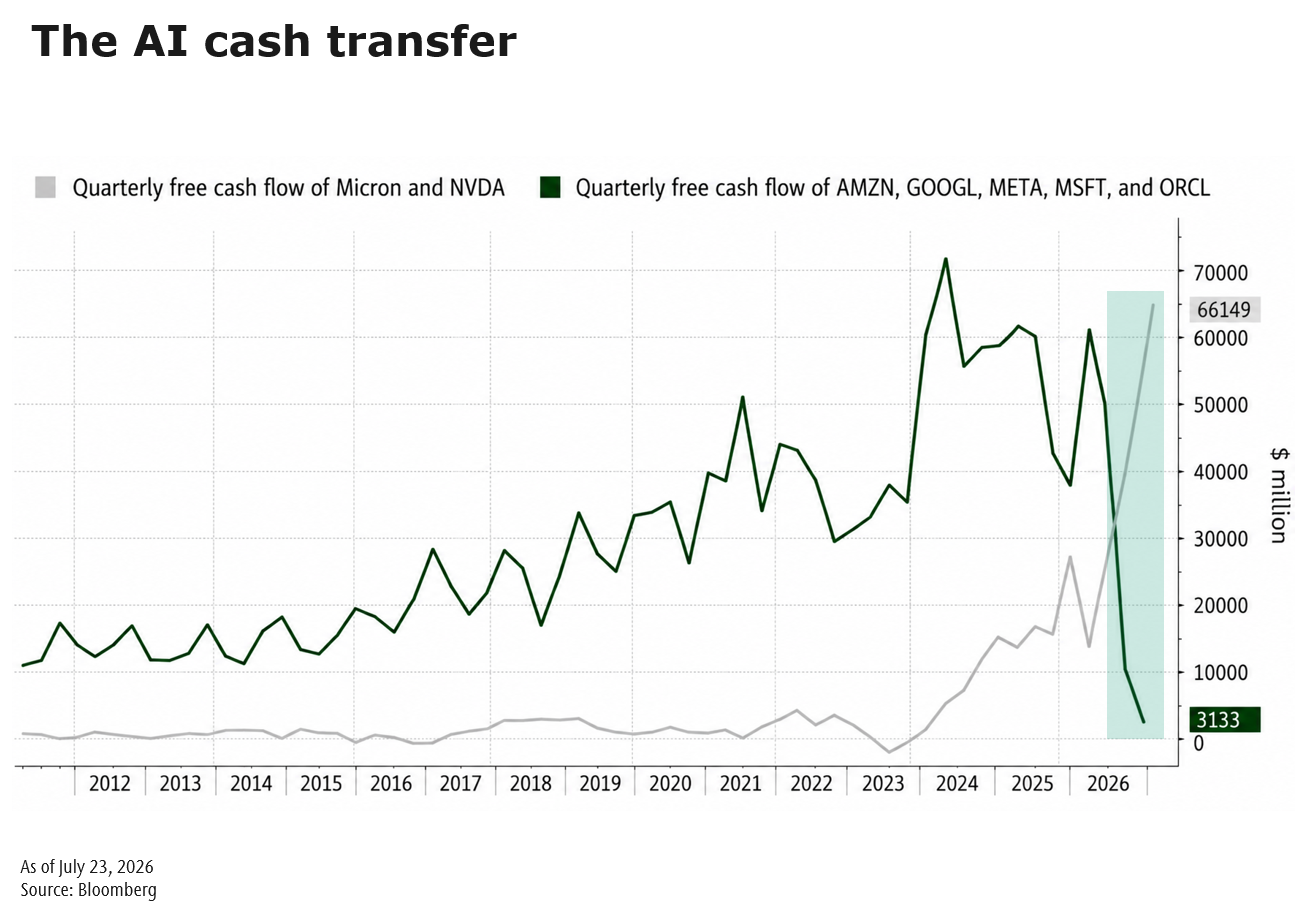
The latest technology selloff does not mean demand for artificial intelligence (AI) is disappearing. Alphabet’s cloud business grew 82% in the latest quarter, well-ahead of expectations. The concern is how much companies must spend to deliver that growth. Alphabet raised its 2026 investment forecast to as much as $205 billion. Further, its quarterly spending pushed free cash flow — the cash remaining after operating expenses and capital investment — below zero for the first time in its history as a public company.
The chart below captures the broader shift. The combined free cash flow of five major AI spenders has fallen significantly, while cash generation among chipmakers has surged. In effect, money is moving from the companies building AI systems to the suppliers selling the chips and equipment. This does not invalidate the long-term AI opportunity, but it raises the standard: investors increasingly want evidence that spending is creating new revenue and profits, not simply larger data centres and higher financing needs.
Why inflation uncertainty matters
The deeper economic risk is not only higher inflation, but less predictable inflation. When prices swing sharply, households may delay purchases and businesses have more difficulty setting prices, planning investment and forecasting profits. That uncertainty can lead analysts to reduce earnings expectations and investors to demand a larger cushion before owning stocks.
The bond market faces a similar challenge. Investors typically demand higher yields when inflation and interest-rate policy become harder to forecast, which pushes bond prices lower. Companies, particularly weaker borrowers, may also have to pay a larger premium above government bond yields. That can tighten access to credit and slow the very investment boom that has supported markets.
Where the risks converge
Escalating Middle East tensions have lifted oil prices and increased the risk that inflation re-accelerates, delaying rate relief or potentially forcing the Fed to raise rates again. Money markets now imply roughly a 35% chance of a July rate increase, up from about 10% a week ago, with a hike fully priced by September. That may be too aggressive for the next meeting, as the Fed will likely want several months of inflation data before acting.
Still, the market’s margin for error is narrowing. Stocks have absorbed higher yields for months, but yields are now at new highs for the year just as investors are questioning the return on enormous AI investments. The combination is likely to create continued volatility. The long-term AI theme remains intact, but the next phase will favour companies that can convert investment into durable cash flow — and portfolios that can withstand a less predictable inflation and interest-rate environment.