October 07, 2026

Strong corporate earnings have kept global equity markets advancing this year. Artificial intelligence (AI)-related companies have been the biggest driver of gains. Energy and Canadian bank stocks have also been notable contributors. Energy companies have benefited from higher oil and gas prices, while Canadian banks have been supported by resilient credit conditions and improving margins. Together, these areas have driven much of the market’s return.
The third quarter tested equity market resilience as leadership shifted sharply and stock valuations fell. Beneath the surface, performance diverged more widely across stocks and industries, while a smaller group of companies fuelled more of the market’s gains. The quarter started with AI and other momentum-driven stocks selling off sharply before rebounding as earnings exceeded expectations.
At the same time, concerns about persistent inflation, driven in part by higher oil and gas prices, pushed bond yields higher, while heavy government borrowing and enormous AI investment increased demand for capital. Higher yields reduced the valuations investors were willing to pay for future company earnings and weighed on interest-rate-sensitive sectors, such as utilities and real estate. Strong earnings offset that valuation pressure, leaving most equity markets higher for the quarter.
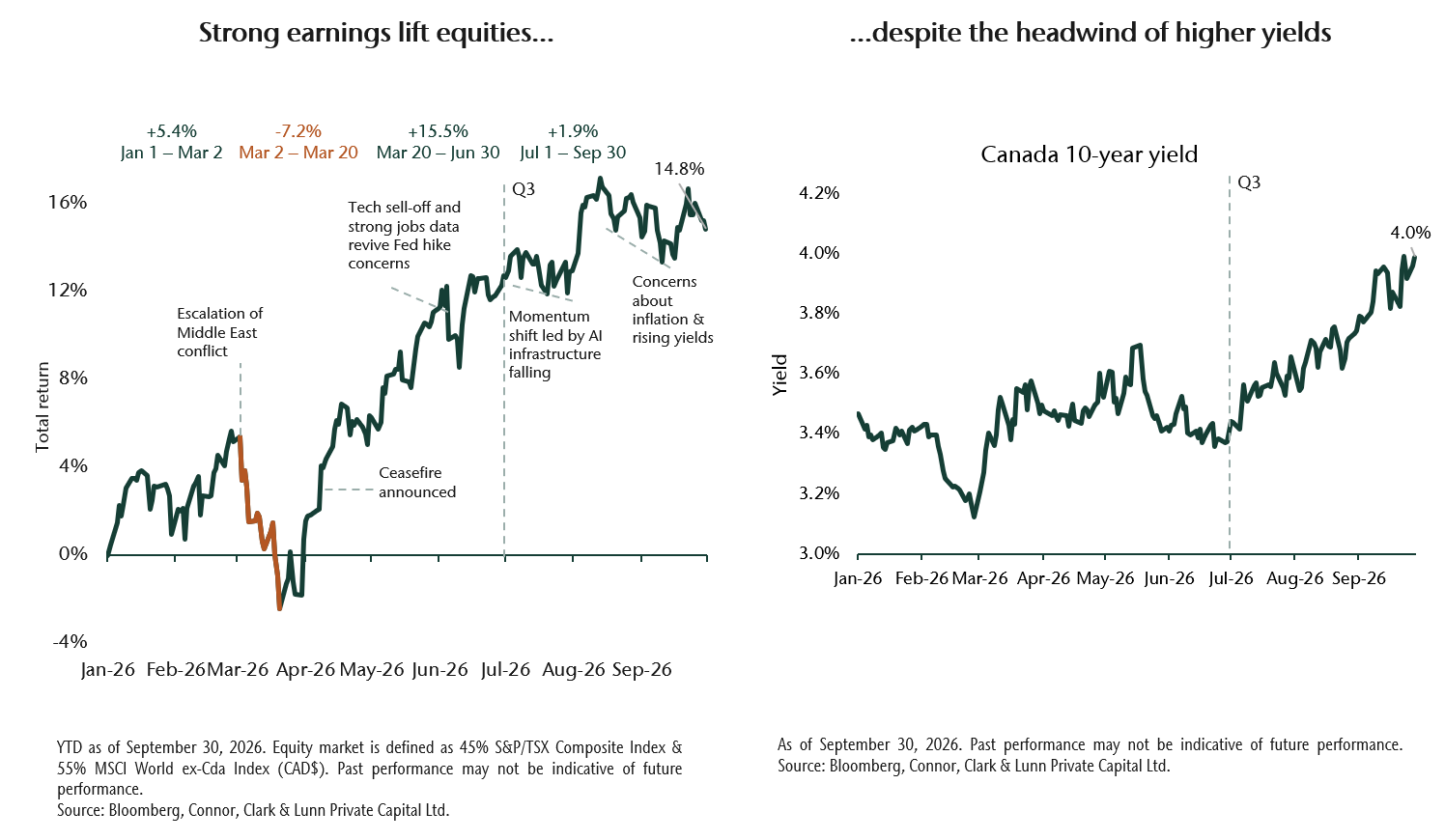
Higher yields had the opposite effect on fixed income, pushing traditional bond returns into negative territory for the year. Shorter-term and higher-yielding strategies held up better because they were less sensitive to rising rates and benefited from a larger income cushion. While rising yields are a near-term headwind for existing holdings, they also improve return potential looking forward.
Portfolio strategy
The backdrop remains supportive and we maintain a modest overweight in equities across client portfolios. Earnings growth is expected to stay strong this year and next, helping to offset pressure from higher yields and lower valuations. AI-related companies remain an important source of growth, but we expect earnings to broaden beyond this theme.
Within equities, we are expanding the strategies we use to pursue opportunities by adding quantitative approaches alongside our fundamental managers. Quantitative strategies use large amounts of data and a consistent, rules-based process to evaluate a much larger universe of companies. This adds diversification and a differentiated source of return. We also continue to see strong opportunities for fundamental active management in Canadian, developed international and emerging markets, where markets are generally less concentrated and less efficient. Our goal is to combine complementary approaches to improve returns, increase the consistency of returns and manage risk more effectively over time.
In fixed income, higher yields continue to pressure traditional bonds, but our positioning has helped protect capital. Shorter-duration and diversified credit strategies are less sensitive to rising yields, while market-neutral strategies have provided returns that are less dependent on the direction of either bond or equity markets. We expect yield pressures to persist for now, although higher starting yields are steadily improving the longer-term opportunity in traditional bonds.
Greater dispersion across companies and industries is creating a more favourable backdrop for active management. Wider differences in company performance and valuations should provide more opportunities for our fundamental and quantitative strategies to add value over time.